Galactic Habitable Zone: Finding a Quiet Suburb
In the vast expanse of the Milky Way, as in real estate, location is everything. But instead of schools and commute times, we’re talking radiation, black holes, and supernova risks. Forget that downtown loft, it’s probably lethal. And that sprawling ranch on the outer rim? Beautiful view, but utterly barren. Finding a habitable planet in our galaxy is like finding the perfect suburban home: it requires a delicate balance of factors found in the Galactic Habitable Zone.
This balance is far more intricate than finding a good school district. It demands a deep understanding of astrophysics and a healthy dose of cosmic luck. Just as a real estate agent emphasizes the importance of location, location, location, astronomers stress the critical role of a star’s galactic address in determining its potential to host life.
Galactic Real Estate: The Good, the Bad, and the Empty
Imagine the Milky Way as a sprawling metropolis. The galactic core is a densely packed downtown area, teeming with activity… and danger. Supermassive black holes lurk, spewing out intense radiation. Stellar density is incredibly high, meaning frequent close encounters with other stars, not ideal for a stable planetary system. The sheer gravitational forces in this region also create significant tidal stresses on any orbiting planets, making stable orbits difficult to maintain. Conversely, the outer galactic suburbs are sparsely populated.
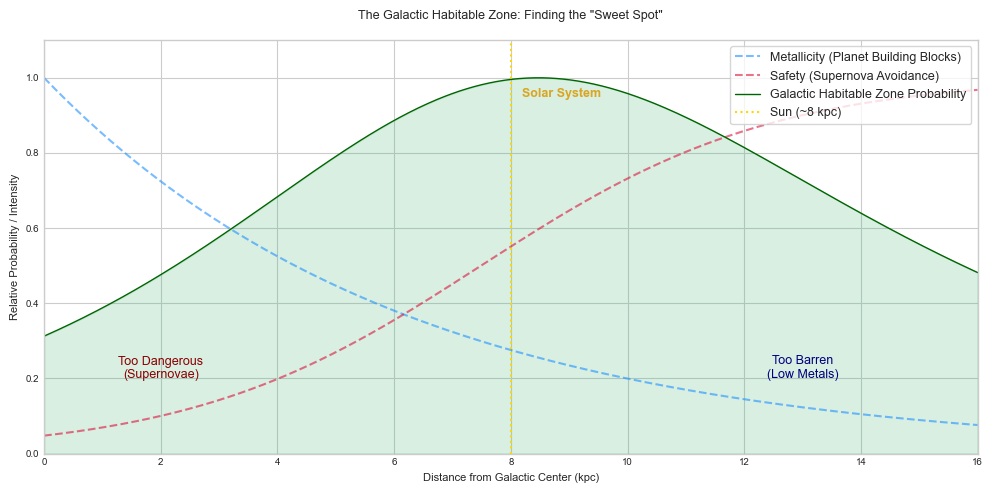
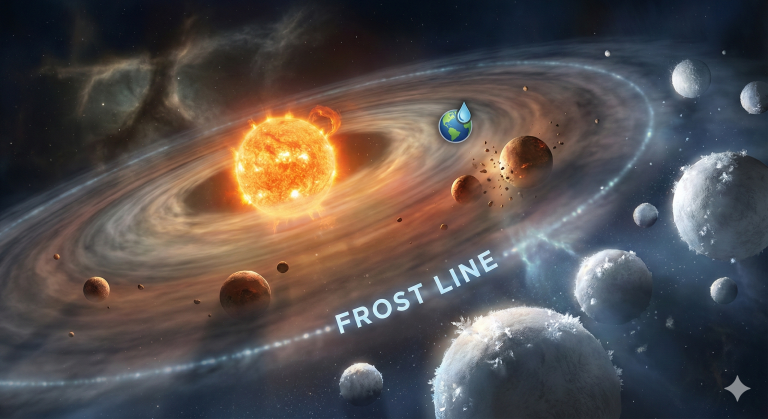
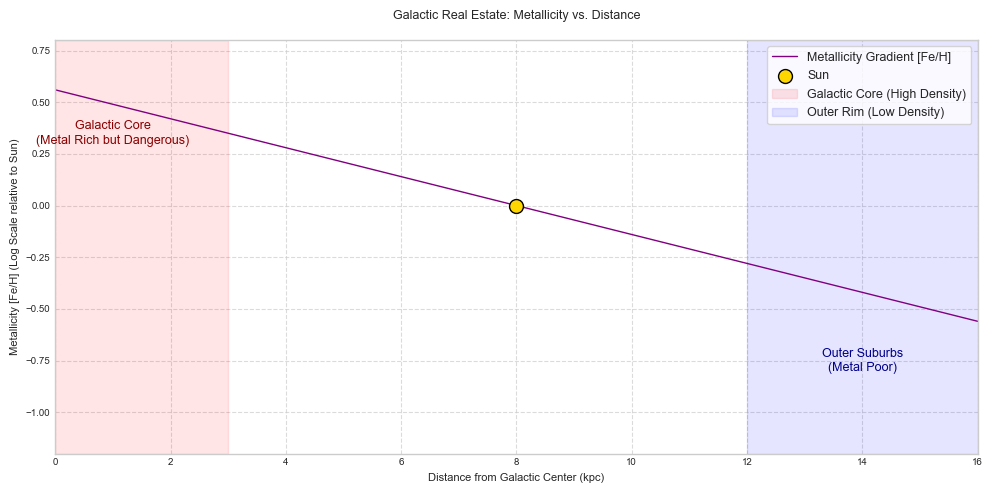
Low metallicity means a lack of heavy elements needed to form rocky planets. It’s a cosmic wasteland of gas and dust, beautiful to look at, but not exactly a place to raise a family…or evolve a civilization. Imagine trying to build a house with only hydrogen and helium; it’s simply not possible. The outer regions are also colder, making it harder for liquid water, crucial for life as we know it, to exist.
The Goldilocks Ring: The Galactic Habitable Zone
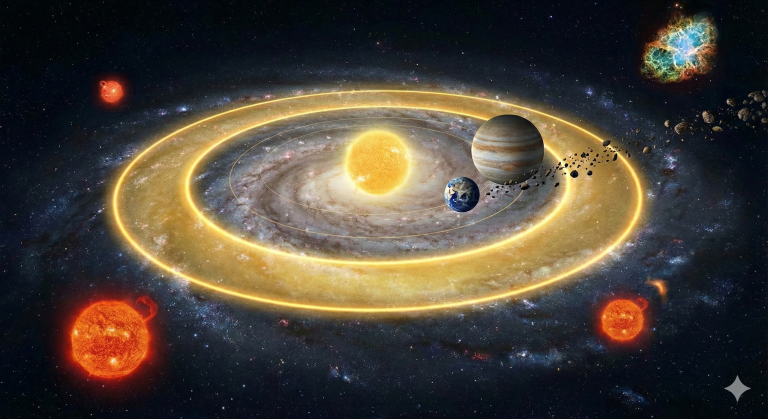
So, where’s the sweet spot? Even though there isn’t a consensus, some astronomers hypothesize the existence of Galactic Habitable Zone (GHZ), a thin, annular region within the galaxy where conditions are “just right” for life to emerge [1][2]. This zone strikes a balance between extremes. We need enough metallicity, the abundance of elements heavier than hydrogen and helium, to form rocky planets like Earth. Without sufficient metals, planets would likely be gas giants, unsuitable for intelligent life.
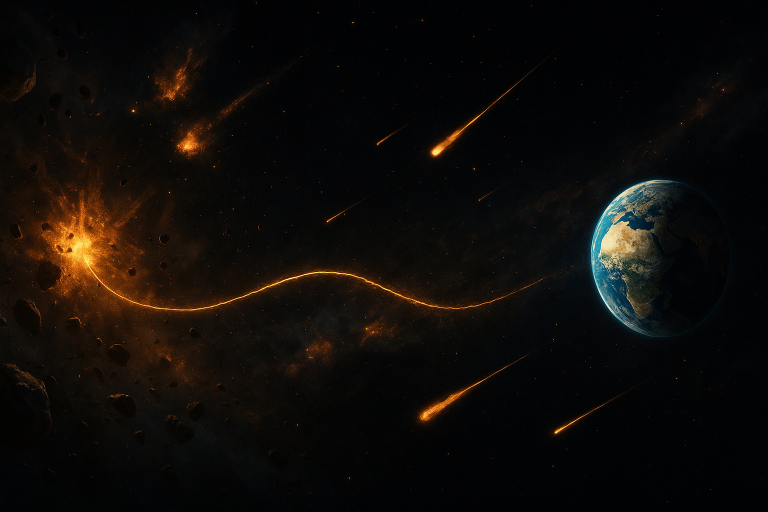
We also need a low enough stellar density to avoid frequent cataclysms, like supernovae going off next door. Supernovae are incredibly powerful explosions that can sterilize entire star systems, making it impossible for life to survive [3]. The GHZ represents a delicate equilibrium, a haven amidst galactic chaos.
Surfing the Spiral Waves: A Risky Proposition
Our galaxy’s spiral arms aren’t static structures; they’re density waves. Imagine a cosmic traffic jam where stars, gas, and dust bunch up. These regions are hotbeds of star formation, which means they’re also hotbeds of supernovae. Crossing a spiral arm is like driving through a war zone. The increased exposure to intense radiation and stellar ejecta poses a significant threat to any life trying to establish itself.
Frequent passages through spiral arms increases supernova risks significantly. Furthermore, the gravitational perturbations within the spiral arms can disrupt planetary orbits, potentially leading to catastrophic collisions or ejection from the star system. These waves are a constant source of turmoil, making them inhospitable to life.
The Sun’s Special Orbit: Staying Out of Trouble
The Sun occupies a particularly fortunate position within the Milky Way. It resides near the co-rotation radius, meaning its orbital speed closely matches the speed of the spiral arms’ rotation. This keeps us synchronized with the “inter-arm” voids, the relatively empty spaces between the spiral arms. As a result, the Sun has avoided spending extended periods within these dangerous zones for billions of years. Our relatively circular orbit keeps us out of harm’s way. This also contributes to the long-term climate stability on Earth, allowing life to flourish without extreme variations. The stability of our orbit is a testament to the fine-tuning of our galactic environment.
The 95% Filter: Galactic Dead Zones
Consider the possibility of a “probability filter” operating on a galactic scale. Perhaps 95% of stars exist in “bad neighborhoods”, regions with either too much radiation, too little metallicity, or too frequent stellar encounters. Life may arise in these places, but it’s quickly extinguished. This filter could be a combination of factors, each posing a significant challenge to the emergence and survival of life. Our very existence suggests that our solar system has cleared this filter. What seems like boring stability to us is, in reality, an essential survival trait. This concept is related to the Rare Earth Hypothesis, which posits that the conditions required for complex life are exceptionally rare [4].
Why this matters for intelligent life
Understanding the Galactic Habitable Zone isn’t just about abstract astrophysics. It has profound implications for the search for extraterrestrial intelligence (SETI). If life requires specific galactic environments, then we can refine our search by focusing on stars within the GHZ, residing outside of spiral arms, and possessing the right metallicity. By targeting our search in these regions, we increase the likelihood of finding potentially habitable planets. It also offers perspective on our place in the universe.
The delicate balance of factors that allowed life to evolve on Earth is likely incredibly rare, making our existence all the more precious. Realizing the challenges involved helps us appreciate the relative safety and stability we currently enjoy. It encourages us to protect our planet and cherish the unique conditions that have allowed us to thrive.
A Quiet Suburb: The Ultimate Oasis
Ultimately, our solar system is a galactic suburb, a rare oasis of stability. We’re far from the dangerous downtown core, shielded from frequent supernovae, and bathed in just the right amount of starlight. This quiet, uneventful existence allowed evolution the vast timescale needed to build a brain, develop language, and ponder our place in the cosmos [5]. We have to understand these astrophysical constraints to appreciate our fortune. We are incredibly lucky to have found ourselves in such a favorable location in the galaxy.
But even in the best neighborhood, the foundations matter. How did our Earth form from the swirling chaos of the early solar system? And what series of incredible events allowed it to evolve into the life-sustaining haven we know today? Join us next time as we journey back to the solar system’s turbulent beginnings and explore the making of a habitable world. The story of Earth’s formation is a captivating tale of cosmic collisions, geological transformations, and the incredible resilience of life.
References
- [1] Lineweaver, C. H., Fenner, Y., & Gibson, B. K. (2004). The galactic habitable zone and the age distribution of complex life in the Milky Way. Science, 303(5654), 59–62.
- [2] Spitoni, E., Matteucci, F., & Sozzetti, A. (2014). The galactic habitable zone of the Milky Way and M31 from chemical evolution models with gas radial flows. Monthly Notices of the Royal Astronomical Society, 440(3), 2588–2598.
- [3] Brunton, I. R., O’Mahoney, C., Fields, B. D., Melott, A. L., & Thomas, B. C. (2023). X-ray-luminous supernovae: Threats to terrestrial biospheres. The Astrophysical Journal, 947(2), Article 42.
- [4] Forgan, D. H., & Rice, K. (2010). Numerical testing of the Rare Earth hypothesis using Monte Carlo realisation techniques. International Journal of Astrobiology, 9(2), 73–80.
- [5] Barros, D. A., Pérez-Villegas, A., Michtchenko, T. A., & Lépine, J. R. D. (2021). Dynamics of the spiral-arm corotation and its observable footprints in the Solar Neighborhood. Frontiers in Astronomy and Space Sciences, 8, Article 644098.
- [6] Genovali, K., Lemasle, B., Bono, G., Romaniello, M., Fabrizio, M., Ferraro, I., & Thévenin, F. (2014). On the fine structure of the Cepheid metallicity gradient in the Galactic thin disk. Astronomy & Astrophysics, 566, A37.
- [7] Johnson, J. L., & Li, H. (2012). The first planets: The critical metallicity for planet formation. The Astrophysical Journal, 751(2), 81.