The Cosmic Lottery: Our Unique Place in the Milky Way
The universe is ancient and vast. With 100 to 400 billion stars in the Milky Way alone, the statistical probability of intelligent life seems overwhelming. Yet, when we scan the heavens, we see nothing but silence. This discrepancy; between the high probability of extraterrestrial civilizations and the complete lack of evidence for them; is known as the Fermi Paradox. Did we hit the cosmic lottery?
It forces us to confront a chilling possibility: perhaps we are alone. Scientists and philosophers have proposed various explanations for this “Great Silence”.
Explanation | Core Idea |
The Great Filter | The path to intelligence is blocked by one or more highly improbable evolutionary steps. |
Rare Earth | Earth’s specific geological and astronomical conditions are extraordinarily unique. |
Self-Destruction | Civilizations tend to destroy themselves (nuclear/environmental) shortly after achieving technology. |
“We’re Early” | The universe has only recently become habitable enough for complex life; we are the first. |
Hidden / Quiet | Civilizations exist but actively avoid detection (the “Dark Forest” theory). |
Wrong Assumptions | Intelligence doesn’t expand, signal using radio waves, or behave as we expect. |
In this three-part blog series, we will explore the Great Filter and Rare Earth hypotheses. We will dismantle the history of our own existence to identify the specific “hard steps” that Earth had to survive.
The Series Roadmap:
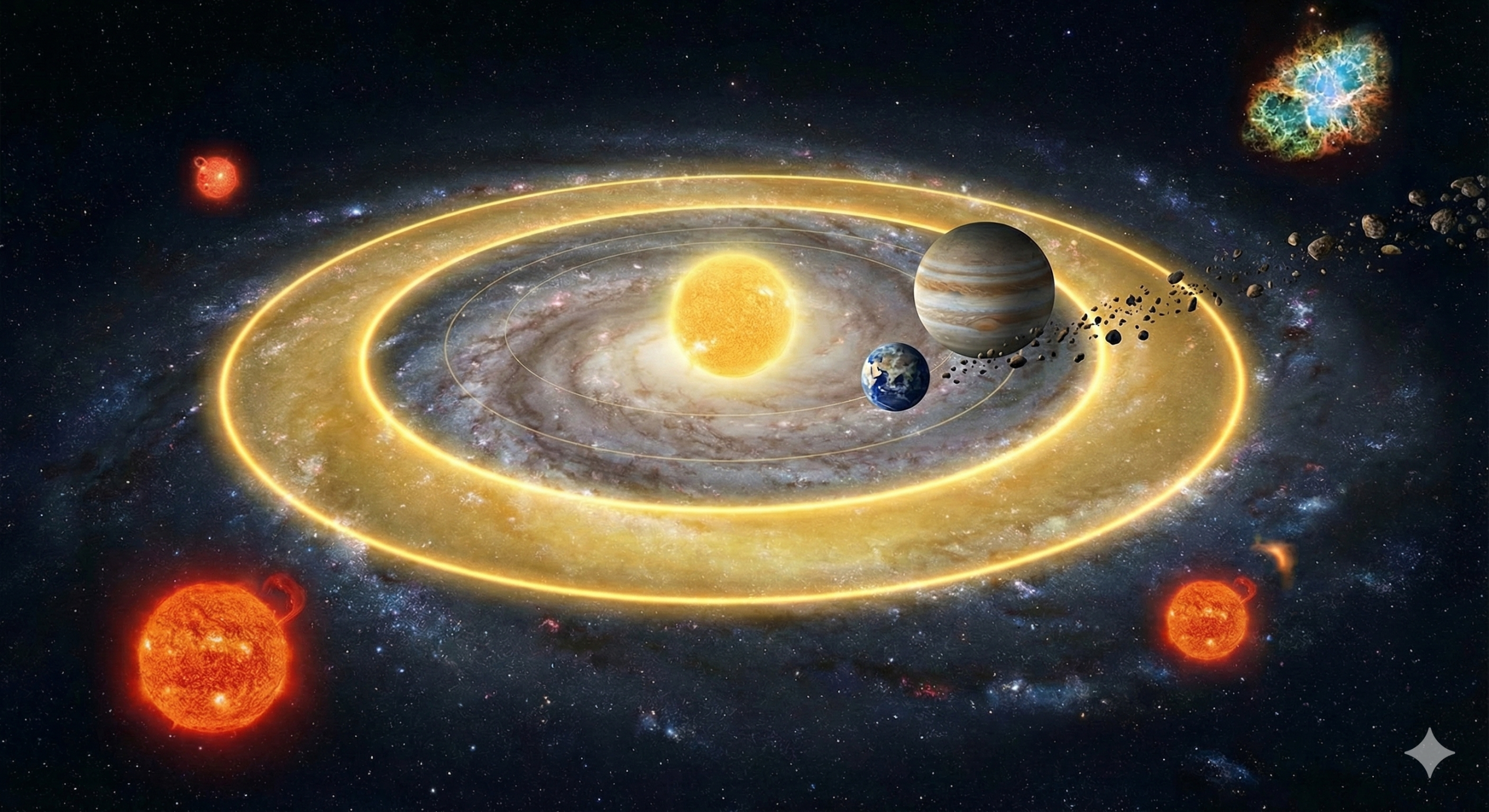
- The Cosmic Lottery (Astrophysical Conditions): We begin by looking at the galaxy itself. We will explore why our specific location in the Milky Way, the stability of our Sun, and the protection of Jupiter were critical prerequisites for life.
- The Goldilocks Rock (Planetary Conditions): We will zoom in to Earth’s geological history. From the collision that formed our Moon to the onset of plate tectonics, we will examine the planetary engines that kept Earth habitable for four billion years.
- The Spark of Life (Biological Bottlenecks): Finally, we will investigate the biological singularities. We will look at the improbable leap from chemistry to biology (Abiogenesis) and the unique merger that created complex cells (Eukaryogenesis), asking if these are inevitable outcomes or cosmic flukes.
The Cosmic Lottery (Astrophysical Conditions)
While the Milky Way contains hundreds of billions of stars, the vast majority are cosmic death traps rather than cradles for life. The silence of the universe may not be a biological mystery but a matter of real estate: to host intelligence, a planet must reside in the narrow “Galactic Habitable Zone”. Before the first cell can form, a star system must win a jackpot of astrophysical stability.
1. The Galactic Habitable Zone: Location, Location, Location
Just as a planet has a “habitable zone” (the distance from a star where water can exist as a liquid), our entire galaxy has a Galactic Habitable Zone (GHZ). This is a surprisingly narrow ring, estimated to lie between 7 and 9 kiloparsecs (roughly 23,000 to 29,000 light-years) from the galactic center [1].
Life in the Milky Way is constrained by two opposing, lethal forces:
- The Metallicity Constraint: “Metallicity” is astronomer-speak for elements heavier than hydrogen and helium; specifically the iron, silicon, and carbon needed to build rocky planets. These elements are synthesized in the cores of massive stars and distributed by supernovae. The outer regions of the galaxy are ancient and “metal-poor.” Without high metallicity, a star system cannot form rocky, Earth-mass planets; it produces only gas giants or nothing at all [2].
- The Radiation Trap: The inner galaxy is rich in metals but is a cosmic shooting gallery. The density of stars in the galactic core increases the frequency of cataclysmic Type II supernovae [2]. A supernova occurring within 30 light-years of a biosphere would destroy its ozone layer, exposing surface life to lethal UV and X-ray radiation [2].
We exist in the “Goldilocks” region: close enough to the center to have the heavy elements required for a rocky crust, but far enough away to avoid being sterilized by exploding neighbors. Furthermore, our Sun’s orbit is exceptionally circular and synchronized with the galaxy’s rotation, keeping us in the quiet “inter-arm” regions and out of the deadly spiral arms where supernovae are concentrated [3].
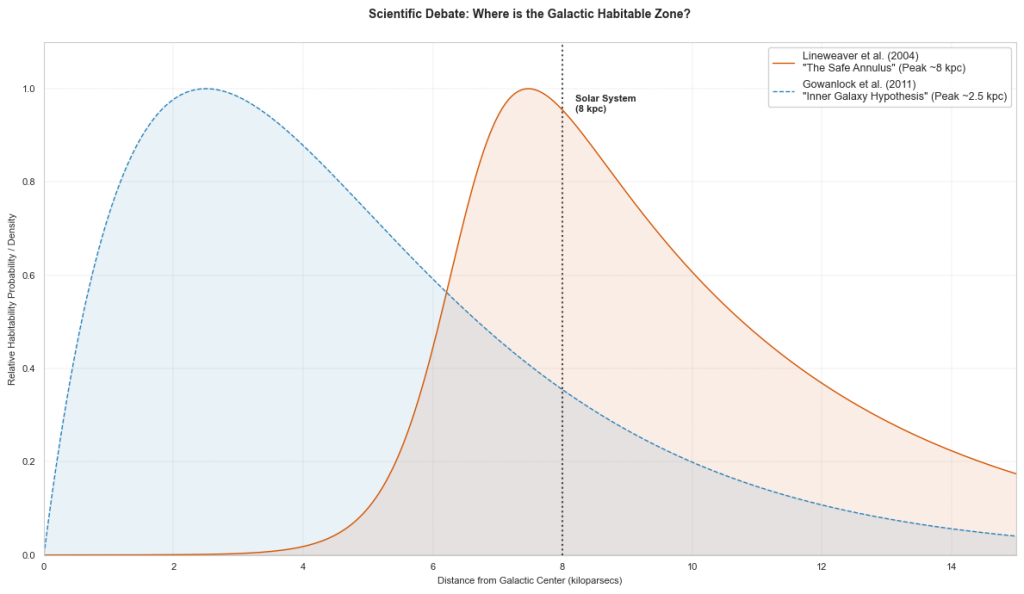
Recent work suggests that the Galactic Habitable Zone should be understood not as a rigid ring but as a probabilistic, time-evolving region, shaped by declining supernova rates and gradual chemical enrichment. Nevertheless, both metallicity and radiation hazards continue to impose strong constraints on where complex life can endure over billions of years [4].
2. Stellar Stability: The Problem with Red Dwarfs
Not all stars are created equal. For intelligent life to evolve, a star must offer stability on the timescale of billions of years.
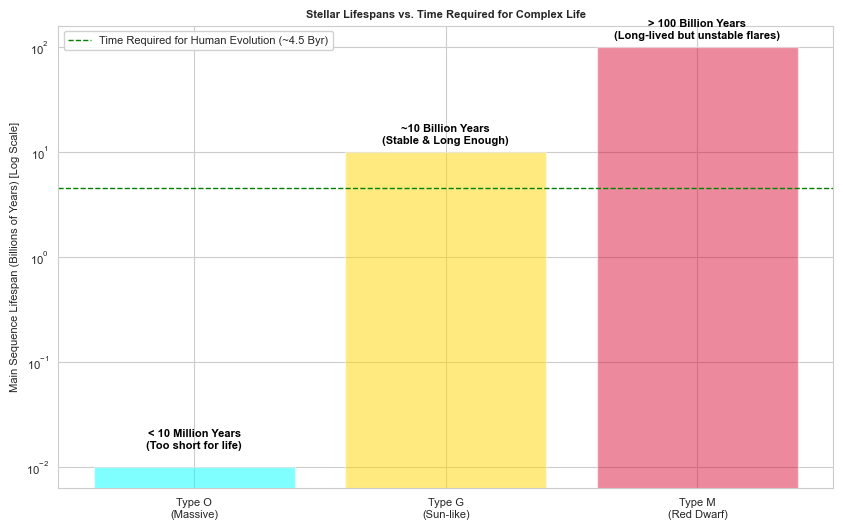
- Massive Stars (Type O/B): These stars burn through their fuel in a few million years and end their lives in violent supernovae. While they forge the heavy elements needed for life, their lifespans are far too short to host it [5].
- Red Dwarfs (Type M): These stars dominate the galaxy by number and can burn for trillions of years. However, they exhibit intense magnetic activity, frequent flares, and prolonged high-energy radiation that can erode planetary atmospheres, particularly for planets orbiting close enough to remain warm [5].
- The Yellow Dwarf (Type G): Our Sun is a relatively rare G-type main-sequence star, burning hydrogen steadily through a long-lived equilibrium between gravity and radiation pressure [5]. It is massive enough to keep our “habitable zone” far away from dangerous tidal forces, yet stable enough to burn steadily for 10 billion years. Humanity emerged roughly 4.5 billion years into the Sun’s life [6]. If our star had been slightly more volatile, the window for intelligence would have slammed shut eons ago.
3. The Jupiter Shield: Guardian or Sniper?
Even if a planet forms in the right galactic zone around the right star, it faces the threat of bombardment. This is where the “Jupiter Shield” hypothesis comes into play [7].
Jupiter is immense; 318 times the mass of Earth [7]. Its gravity dominates the outer solar system. Historically, astronomers believed Jupiter acted as a vacuum cleaner, sweeping up debris and deflecting long-period comets from the Oort cloud away from Earth [7].
Modern dynamical simulations paint a more nuanced picture. Whether a gas giant protects or endangers inner planets depends critically on its mass and orbital configuration:
- The “Good” Jupiter: A full Jupiter-mass planet in a stable, near-circular orbit (as in our Solar System) tends to eject long-period comets from the system entirely, reducing impact rates on inner worlds [8].
- The “Bad” Jupiter: A smaller or more eccentric gas giant, roughly Saturn-mass or on an unstable orbit, may fail to eject debris. Instead, it can perturb objects just enough to send them inward, acting less like a shield and more like a sniper directing impacts toward the habitable zone [8].
We are incredibly lucky to have a “Good Jupiter”. Many exoplanetary systems feature “Hot Jupiters” on eccentric orbits that would have destabilized Earth long ago [8].
The Bottom Line
The universe may be quiet not because life is impossible, but because sustained habitability is rare. To stand on a rocky world orbiting a stable star, protected by a well-placed gas giant, in a chemically rich yet astrophysical calm region of a spiral galaxy, is to have won a jackpot of astronomical proportions.
Astrophysical conditions do not guarantee life, but they determine whether life is ever given the uninterrupted time it needs to evolve complexity. Long before biology faces its own bottlenecks, the cosmos itself has already imposed its filters.
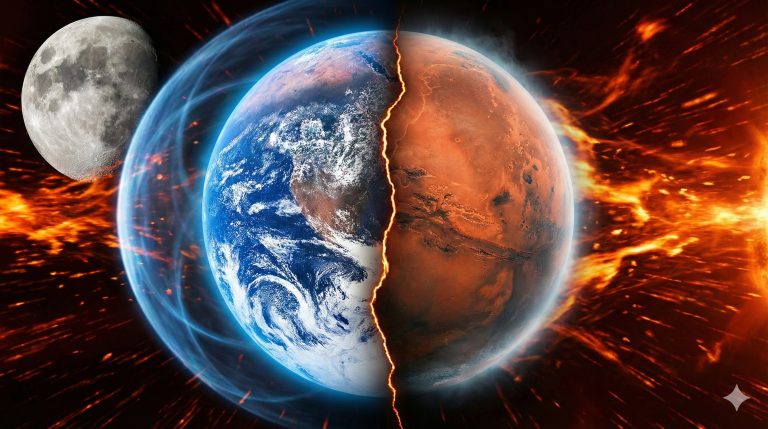
Next in the series: Surviving the galactic lottery was just the first step. In our next post, “Three Shields Against Chaos: Why Earth Survived When Mars Died,” we zoom in from the Milky Way to our own neighborhood. Four billion years ago, Earth and Mars started as near-twins, but today one is alive and the other is a frozen wasteland. We will explore the critical planetary machinery—from a churning molten core to grinding tectonic plates—that saved Earth from the fate of the Red Planet.
References
- Lineweaver, C. H., Fenner, Y., & Gibson, B. K. (2004). The Galactic Habitable Zone and the Age Distribution of Complex Life in the Milky Way. Science, 303(5654), 59-62.
- Gonzalez, G., Brownlee, D., & Ward, P. (2001). The Galactic Habitable Zone: Galactic Chemical Evolution. Icarus, 152(1), 185–200.
- Ward, P. D., & Brownlee, D. (2000). Rare Earth: Why Complex Life is Uncommon in the Universe. Copernicus Books (Springer Verlag).
- Prantzos, N. (2016). On the Galactic Habitable Zone. Astronomy & Astrophysics, 593, A122.
- Hazen, R. M. (2013). The Origin and Evolution of Earth: From the Big Bang to the Future of Human Existence. The Teaching Company.
- Livio, M. (1999). How rare are extraterrestrial civilizations, and when did they emerge?. The Astrophysical Journal, 511(1), 429.
- Horner, J., & Jones, B. W. (2008). Jupiter: Friend or Foe? I: The Asteroids. International Journal of Astrobiology, 7(3-4), 251-261.
- Horner, J., & Jones, B. W. (2009). Jupiter: Friend or Foe? III: The Oort Cloud Comets. International Journal of Astrobiology, 8(2), 75-80.