Three Shields Against Chaos: Why Earth Survived When Mars Died
We live in a shooting gallery. The universe is often romanticized as a peaceful expanse of stars, but in reality, it is a violent, radioactive chaos. Between exploding supernovae, wandering asteroid swarms, and searing solar winds, the cosmos is actively hostile to delicate biology.
For life to persist for 4.5 billion years, it needs more than just water, it needs a fortress. Let’s talk about three shields against chaos.
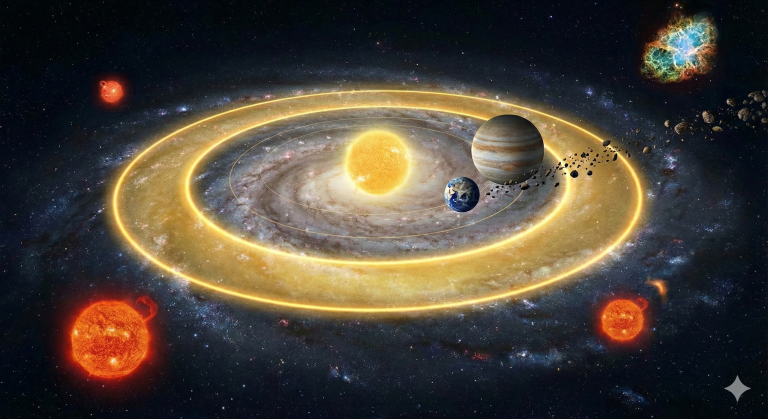
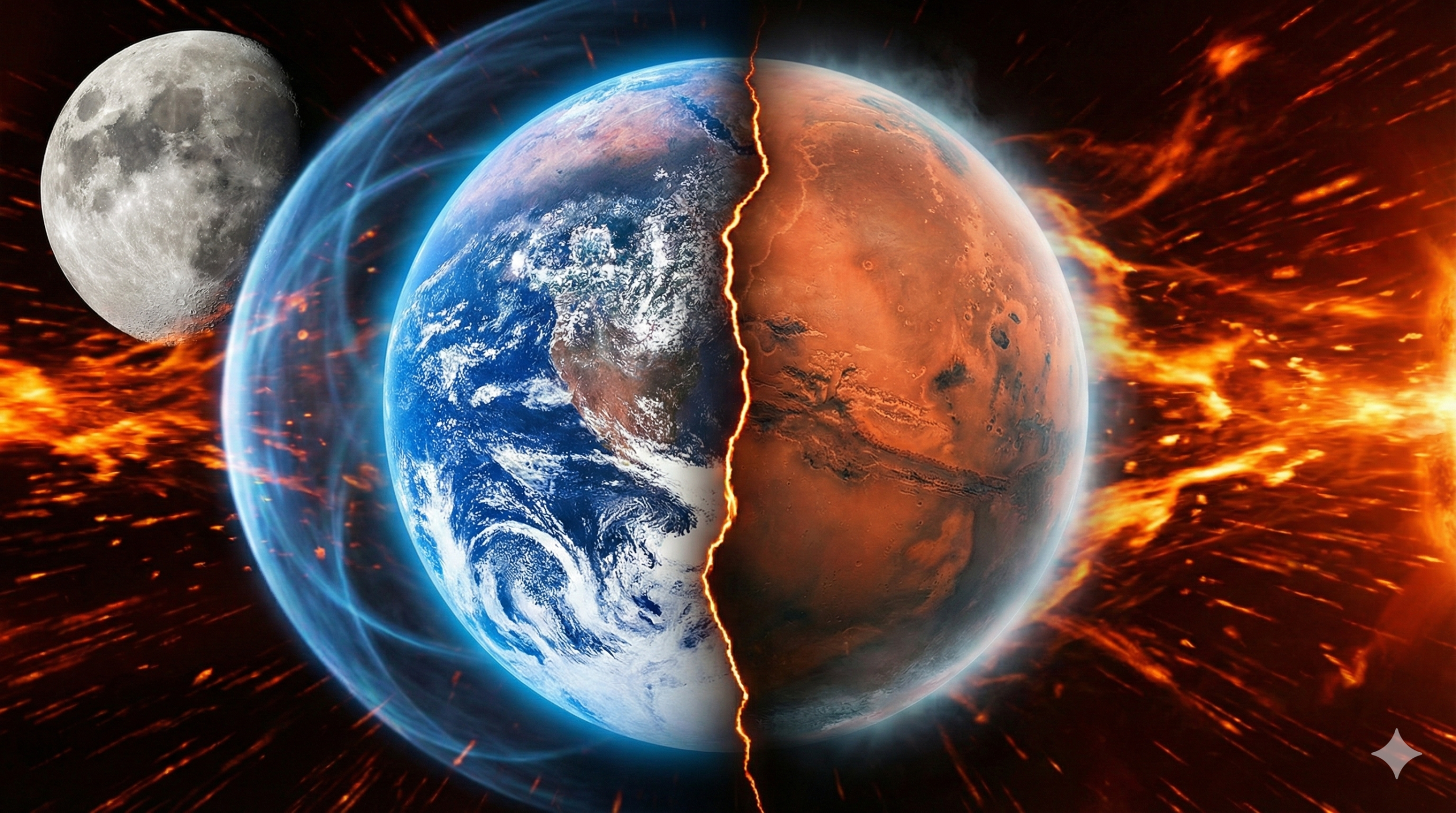
When we look at our neighbors, we see the wreckage of worlds that failed. Mars is a frozen, irradiated desert; Venus is a suffocating furnace capable of melting lead. Only Earth walked the razor’s edge of habitability, protected by three improbable shields that make our planet a “Perfect Cradle.”
1. The Anchor: Our Impossible Moon
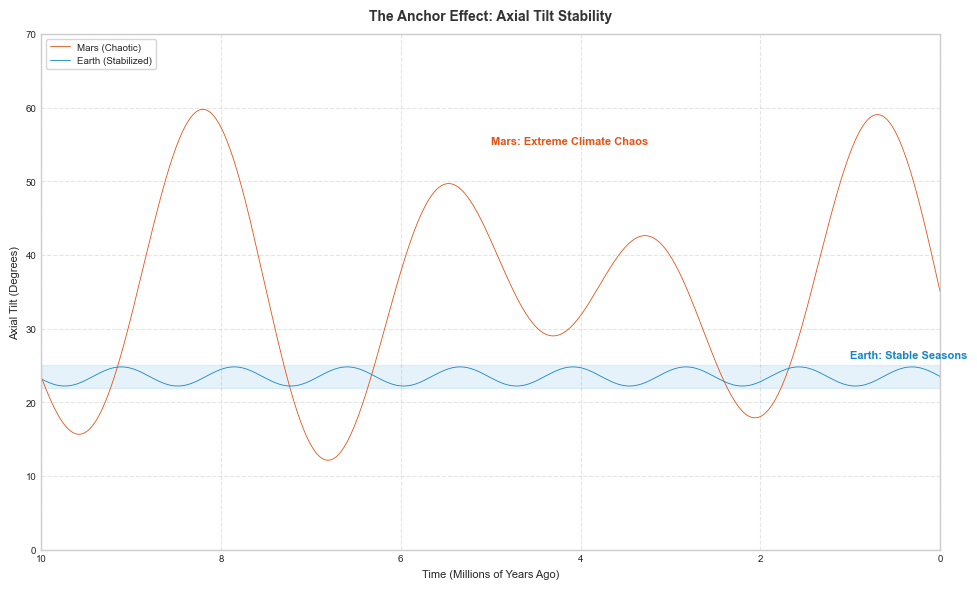
Earth is essentially a spinning top wobbly on its axis. Without a stabilizer, the gravitational tugs of Jupiter and the Sun would cause our planet’s axial tilt (obliquity) to swing wildly over millions of years.
If this happened, the consequences would be apocalyptic. We aren’t just talking about a hotter summer; we are talking about the North Pole tilting directly at the Sun, boiling the Arctic ocean, while the equator plunges into a permanent deep freeze. Then, a few million years later, it would flip back.
Enter the Moon. Formed from a cataclysmic collision between the proto-Earth and a Mars-sized body named Theia 4.5 billion years ago, our Moon is an anomaly. It is enormous relative to its host planet [2]. This “Giant Impact” did more than just light up our night sky; it acted as a cosmic anchor.
The Moon’s gravity grips Earth’s equatorial bulge, stabilizing our tilt at a steady 23.5 degrees. While Mars, lacking a large moon, wobbles chaotically with tilt excursions ranging from 0 to 60 degrees [1], Earth enjoys the reliable rhythm of seasons. This stability is the unsung hero of evolution, providing the millions of years of consistent climate needed for complex life to adapt and thrive.
2. The Thermostat: Plate Tectonics
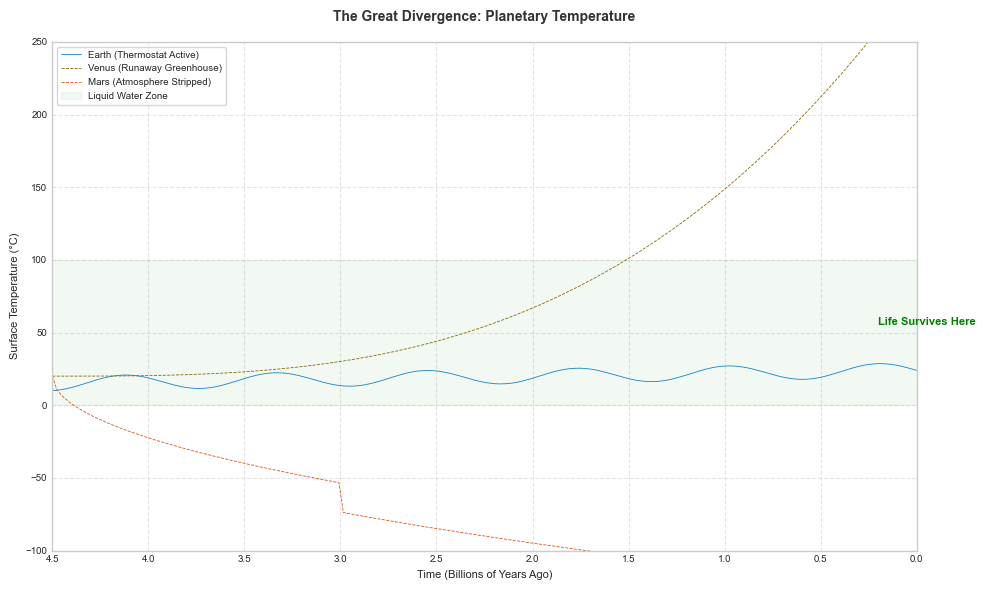
A planet’s climate is unstable by nature. Our Sun has brightened by roughly 30% since the solar system was born. On a stagnant world, this increasing heat would eventually boil the oceans (like Venus) or, if the planet cooled too fast, freeze it solid (like Mars).
Earth escaped both fates because it is the only known planet with active plate tectonics. It acts as a planetary thermostat through the Carbonate-Silicate Cycle [4].
How the Global Thermostat Works:
- When Earth gets too HOT: Rain increases. CO2 dissolves in rain, creating weak acid that weathers rocks. This process sucks carbon out of the air and traps it in limestone on the ocean floor, cooling the planet.
- When Earth gets too COLD: Rain stops. Weathering slows down. Meanwhile, volcanoes continue to erupt, pumping CO2 back into the atmosphere, wrapping the planet in a blanket to warm it up.
Without this recycling engine, Earth would be a “stagnant lid” planet. We would have spiraled into a runaway greenhouse or a permanent snowball Earth billions of years ago.
3. The Force Field: Our Liquid Core
The most invisible yet vital shield is Earth’s magnetosphere. Deep beneath our feet, a churning ocean of liquid iron generates a powerful magnetic field that stretches far into space.
Think of this as a deflector shield in science fiction. It protects us from the Solar Wind, a stream of high-energy charged particles blasting from the Sun at a million miles per hour.
The Mars Warning: Mars illustrates the cost of losing this shield. Because Mars is smaller, its core cooled and solidified billions of years ago. The planetary dynamo stopped.
Without a magnetic field, solar winds stripped away the protective air, and cosmic rays split water molecules, allowing the lighter hydrogen to escape into space [6]. Mars turned from a wet, blue world into a dry, red husk. Earth, with its churning core, kept its shields up, preserving the air we breathe.
The Fortress is Ready… But Empty?
We are not just lucky; we are fortified. The Moon anchors our seasons, the Magma regulates our temperature, and the Magnet shields our air. In a universe hostile to life, Earth is the ultimate bunker.
But a bunker is useless without inhabitants. 4 billion years ago, Earth was a perfect cradle, but it was empty. The stage was set, the shields were active, but the actors hadn’t arrived.
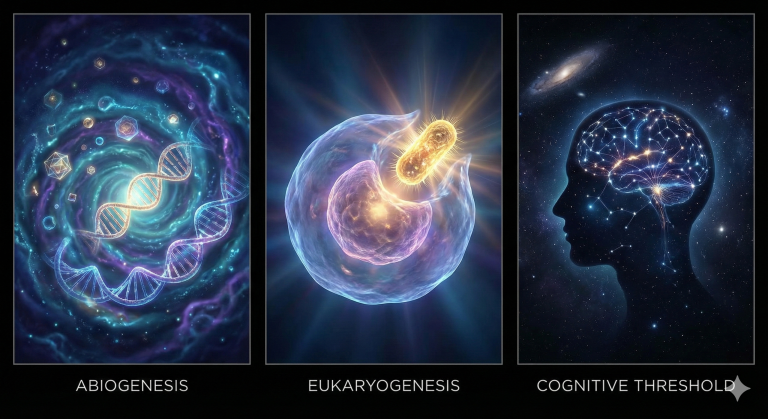
Next in the Series: From Slime to Shakespeare: Beating the Biological Odds (Great Filter), We dive into the mystery of Abiogenesis.
References
- Laskar, J., & Robutel, P. (1993). The chaotic obliquity of the planets. Nature, 361(6413), 608-612.
- Canup, R. M., & Asphaug, E. (2001). Origin of the Moon in a giant impact near the end of the Earth’s formation. Nature, 412(6848), 708-712.
- Ward, P. D., & Brownlee, D. (2000). Rare Earth: Why Complex Life is Uncommon in the Universe. Copernicus.
- Walker, J. C., Hays, P. B., & Kasting, J. F. (1981). A negative feedback mechanism for the long-term stabilization of Earth’s surface temperature. Journal of Geophysical Research: Oceans, 86(C10), 9776-9782.
- Tarduno, J. A., et al. (2010). Geodynamo, solar wind, and magnetopause 3.4 to 3.45 billion years ago. Science, 327(5970), 1238-1240.
- Jakosky, B. M., et al. (2017). Mars’ atmospheric history derived from upper-atmosphere measurements. Science, 355(6332), 1408-1414.