The Giant Impact: 1 Cataclysmic Event That Created Our World
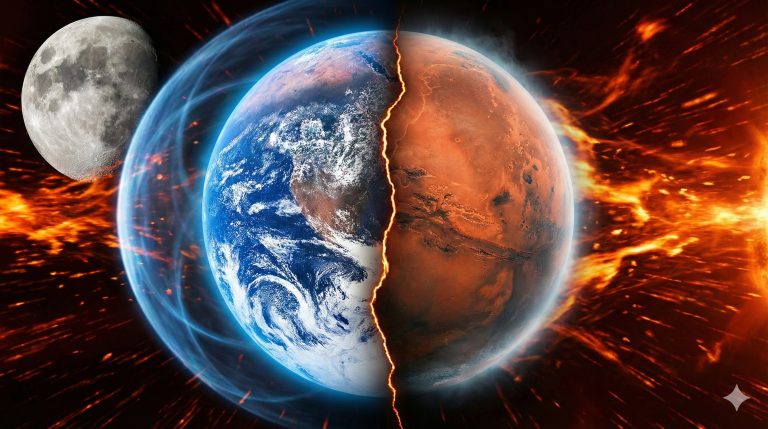
The origins of our “blue marble” are rooted in a prehistoric cataclysm far more violent than most imagine. Billions of years ago, the infant Earth was not a serene world but a fiery, molten sphere. During this volatile period, it was involved in a world-altering event known as the Giant Impact, or the “Big Thwack,” when a Mars-sized protoplanet named Theia slammed into our world. While this collision began with unimaginable destruction, it was actually a stroke of cosmic luck. This article explores how that ancient crash birthed our Moon, stabilized our climate, and paved the way for the evolution of intelligent life.
The Birth of the Moon from Chaos
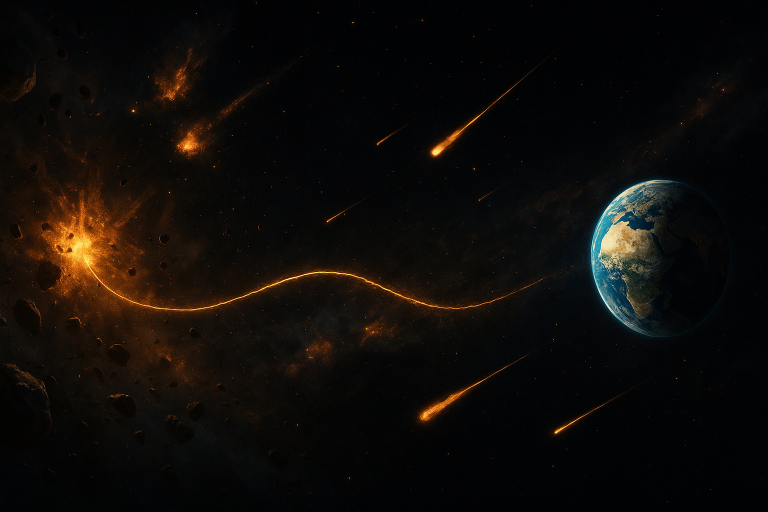
In the early solar system, high-velocity collisions were a common occurrence as planetary bodies vied for space. The impact between Earth and Theia was so immense that it vaporized a significant portion of Earth’s mantle and much of the incoming protoplanet. The force of this impact was massive, ejecting vast amounts of rock and metal into the surrounding space. This resulting debris formed a massive, swirling disk or ring around the newly formed Earth.
Under the relentless pull of gravity, the debris within this ring eventually coalesced to form the Moon. In its early days, the Moon was much closer to Earth than it is now, appearing much larger in the sky and exerting a powerful gravitational influence on the young planet. This violent beginning was profoundly beneficial for the long-term habitability of our planet. The Giant Impact Hypothesis remains the most widely accepted theory for the Moon’s formation, and its implications extend far beyond lunar geology.
The Moon as a Stabilizing Anchor: Lessons from Mars
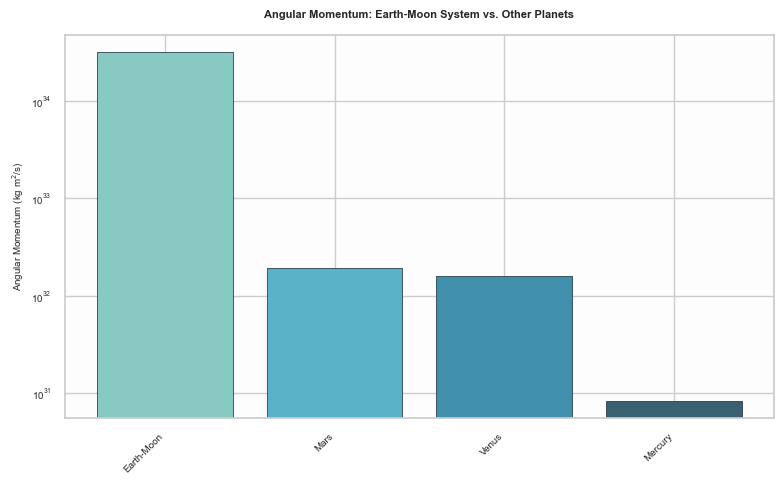
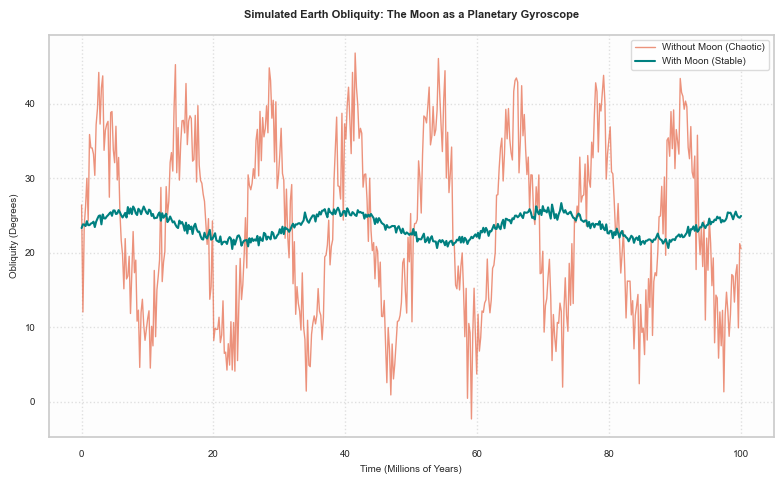
One of the most profound legacies of the “Big Thwack” is the Moon’s role as a planetary gyroscope. It acts as a gravitational anchor, exerting a stabilizing influence on Earth’s axial tilt, or obliquity; the angle between a planet’s rotational axis and its orbital plane. Earth’s current tilt sits at approximately 23.5 degrees, a specific measurement that provides our predictable and reliable seasons. Without the Moon’s constant gravitational interaction, Earth’s tilt would likely be much more unstable, varying wildly over time and leading to dramatic, unpredictable climate swings that would make it exceedingly difficult for complex life to evolve.
To understand the vital importance of this stability, we can look to our neighbor, Mars. Because Mars lacks a large moon to act as a stabilizer, it experiences chaotic variations in its axial tilt, ranging from 0 to 60 degrees over millions of years. These drastic changes trigger extreme climate shifts, such as ice ages at the equator or tropical conditions at the poles [2]. While these chaotic shifts on Mars make the emergence of life difficult, the Moon’s steadying presence has allowed Earth to remain a habitable oasis for billions of years.
The Tidal Engine and the Origin of Life
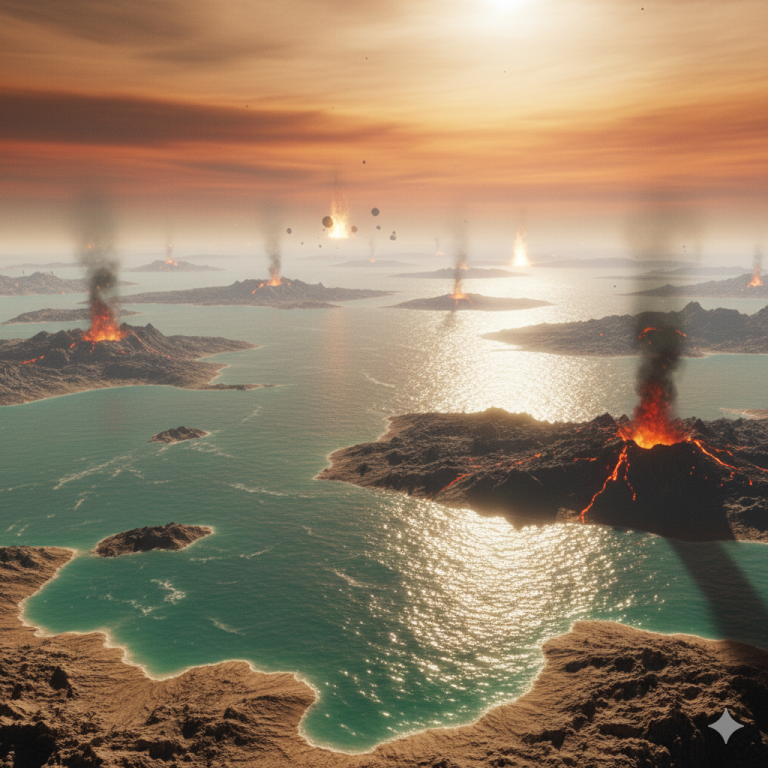
The Moon’s proximity in Earth’s early history created a “tidal engine” that may have jump-started biological processes. Because the Moon was much closer, the early Earth experienced much stronger tides than we do today. These massive tides flooded and receded across coastal areas daily, creating vast intertidal zones that were alternately submerged in water and exposed to the air.
This constant “wet-dry” cycling in intertidal zones may have played a crucial role in prebiotic chemistry. The repeated wetting and drying could have concentrated organic molecules and provided the chemical energy needed for them to combine into more complex structures, such as those necessary for the origin of life. Furthermore, these tidal zones could have provided a unique environment for the evolution of early land adapters, serving as a stepping stone for life to transition from the oceans to the land [3].
Why This Matters for Life?
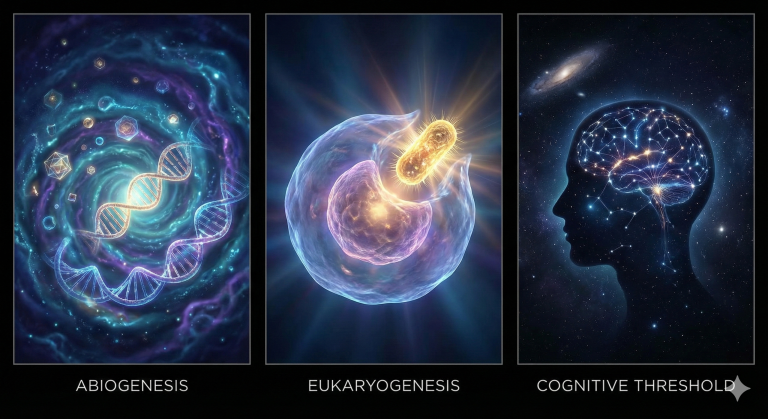
The “Big Thwack” highlights the delicate balance required for intelligent life to survive. A stable climate, underpinned by a reliable axial tilt, is essential for the evolutionary process. Without this consistency, the environmental stability needed for simple organisms to evolve into complex, self-aware beings would likely be absent.
This stabilizing influence was also fundamental to the rise of human society. By securing predictable seasons, the Moon enabled reliable agriculture and animal domestication. This steady food supply allowed early humans to transition from nomadic lifestyles to settled, complex civilizations. Without this cosmic anchor, erratic climate shifts would have made large-scale farming nearly impossible.
Ultimately, the Moon, born from absolute destruction, became our world’s unlikely guardian. By shielding Earth from chaotic climate swings, it provided a biological window of opportunity lasting billions of years. We might not be here to contemplate our origins if not for this violent stroke of cosmic luck..
A Lucky Strike: The Moon as Earth’s Silent Guardian
The Moon is much more than just a beautiful celestial object; it is a cosmic stabilizer and a silent guardian that has played a critical role in making Earth a long-term habitable environment. The Moon is a testament to a violent past and a cosmic accident that transformed Earth from a volatile, molten world into a stable, habitable oasis.
The Giant Impact was a stroke of cosmic luck that set our planet on a path toward life, complexity, and ultimately, self-awareness. Without this cataclysmic event, Earth might have resembled Mars; a cold, barren planet incapable of supporting the evolution of complex life over long periods. The Big Thwack gave us our Moon, our seasons, and our stability, setting the stage for life as we know it.
The story of early Earth doesn’t end with the formation of the Moon, however. While the Big Thwack provided the stability we needed, another element was required for life to truly take hold: liquid water. What were the conditions on this young, volatile planet that allowed water to persist and eventually cover 70% of our surface? Stay tuned for our next blog, “Earth’s Early Oceans: Beyond the Hellscape” as we investigate the possible origins of Earth’s most precious resource.
References
- [1] Canup, R. M, Asphaug, E. (2001). Origin of the Moon in a giant impact near the end of the Earth’s formation. Nature, 412, 708–712.
- [2] Laskar, J., et al. (2004). Long term evolution and chaotic diffusion of the insolation quantities of Mars. Icarus, 170(2), 343-364.
- [3] Damer, B., Deamer, D. (2020). The Hot Spring Hypothesis for an Origin of Life. Astrobiology, 20(4), 508-529.