How Earth Got Its Water: The Frost Line and Jupiter’s Grand Tack
Understanding how Earth got its water is essential to solving the mystery of intelligent life. The secret to our blue marble lies in a specific boundary of the early solar system known as the Frost Line. This invisible thermal divide dictated where ice could survive, separating the dry rocky planets from the water-rich gas giants. By exploring this cosmic architecture and chaotic events like Jupiter’s Grand Tack , we can solve the Water Paradox and understand the precise conditions that transformed a dry rock into a habitable world.
The Birth of a Solar System: From Dust to Disk
It all began with a vast, swirling cloud of gas and dust known as the solar nebula. This giant cloud, the remnant of a long-dead star, started to collapse under its own gravity. As it contracted, it began to spin faster and faster, flattening into a rotating disk [1]. Within this disk, the building blocks of planets were taking shape. Tiny dust grains, mere specks of cosmic debris, collided and stuck together through electrostatic forces, much like how dust clings to a television screen. Over time, these grains grew into larger aggregates, eventually becoming pebble-sized rocks known as planetesimals [2]. This process, called accretion, was the first step in forming the planets we know today.
The T Tauri Wind: A Solar System Blow Dryer
The infant Sun, still in its formative stages, wasn’t the stable star we see today. It went through a period of intense activity known as the “T Tauri” phase. During this phase, the young Sun unleashed powerful solar winds, streams of charged particles, that swept through the inner solar system like a cosmic blow dryer. These fierce winds blasted away the light gases, primarily hydrogen and helium, from the inner regions, leaving behind heavier elements like rock and metal. This is why the inner planets, Mercury, Venus, Earth, and Mars, are primarily composed of these dense materials. This period is estimated to have occurred within the first few million years of the solar system’s formation.
Runaway Accretion: A Cosmic Demolition Derby
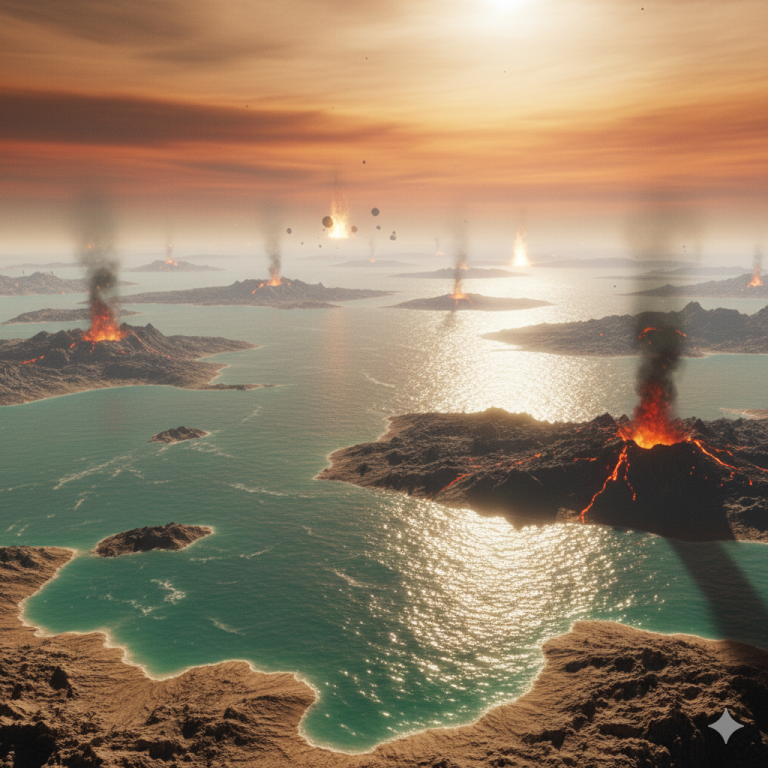
The early solar system was a chaotic place, a cosmic “demolition derby” where planetesimals constantly collided and merged. Some collisions were gentle, allowing planetesimals to gradually grow larger. Others were violent, shattering them into smaller fragments. Through this process of runaway accretion [3], a few dominant planetesimals began to sweep up most of the surrounding material, eventually growing into the protoplanets that would become the planets we know today. This period was crucial in shaping the size and composition of the inner rocky planets, including the proto-Earth.
The Frost Line: Where Water Gets Icy
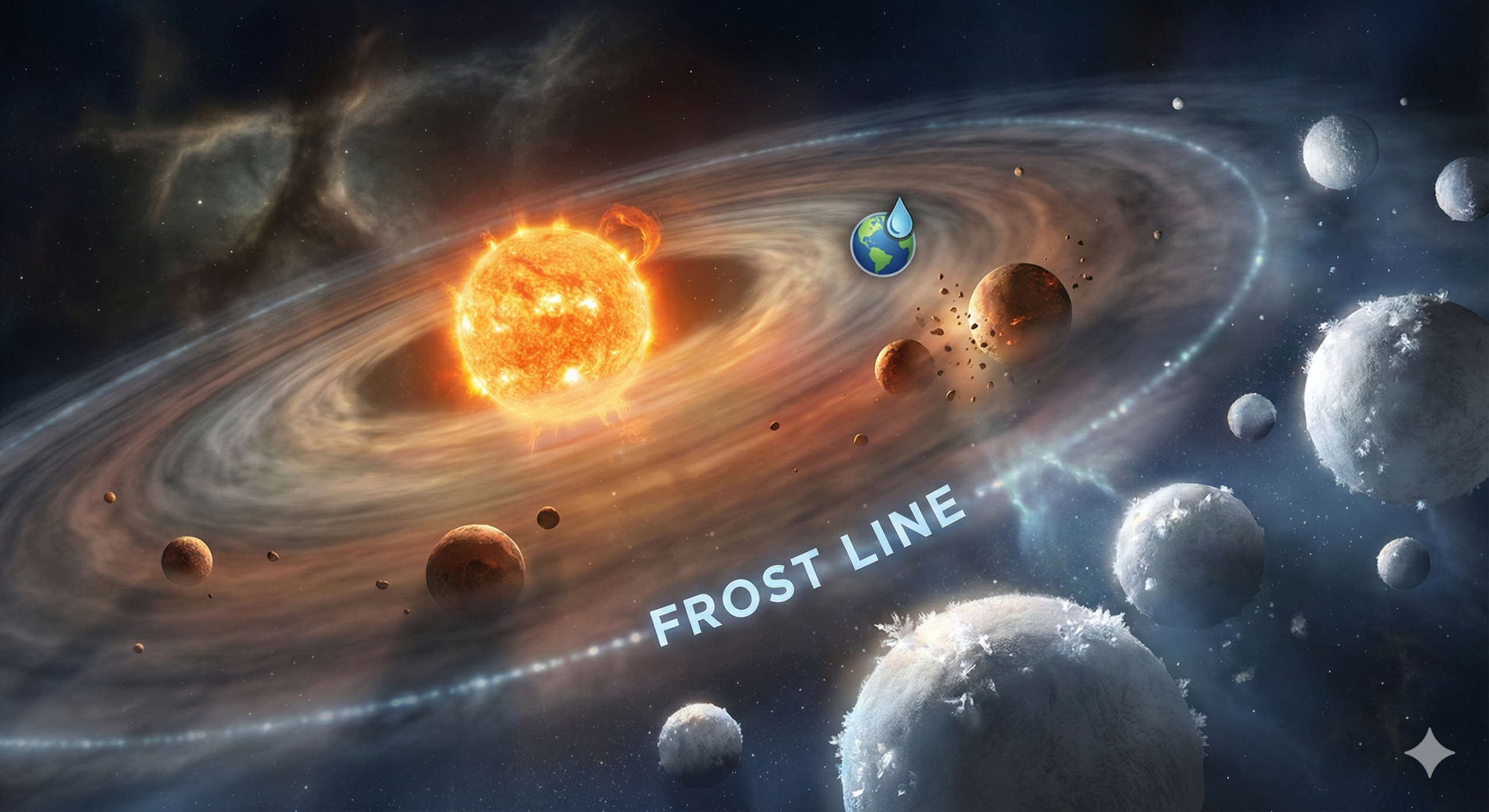
Now, let’s introduce the crucial concept of the frost line, also known as the snow line. Imagine a boundary around the young Sun where it was cold enough for volatile compounds like water, ammonia, and methane to condense into solid ice grains.
Inside the frost line, closer to the Sun, these compounds remained in gaseous form. Outside the frost line, they froze into ice. This temperature difference had a profound impact on planet formation [4]. Inside the frost line, only rocky and metallic materials could condense, leading to the formation of the terrestrial planets. Outside the frost line, the abundance of ice allowed for the formation of much larger planets, the gas giants like Jupiter and Saturn, and the ice giants like Uranus and Neptune.
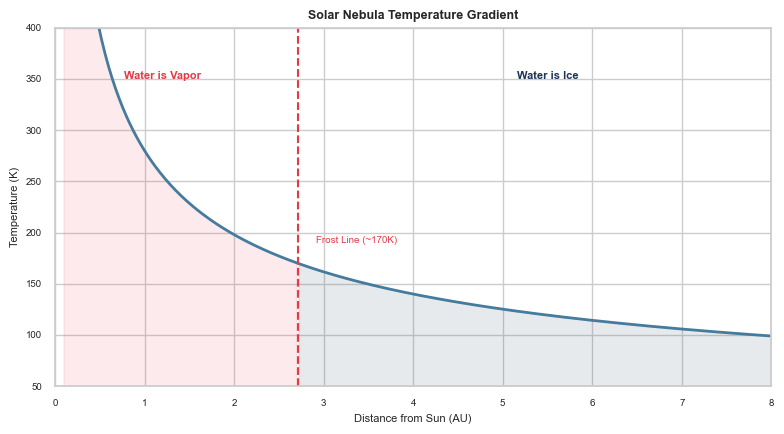
This arrangement, with rocky planets near the star and gas giants further out, is not just a random occurrence; it’s a critical factor for habitability. The gas giants, particularly Jupiter, acted as a “delivery fleet,” gravitationally flinging icy planetesimals and comets, rich in water, inward towards the dry, rocky inner planets. These impacts delivered the water that eventually formed our oceans and made life on Earth possible.
Jupiter: The Grand Tack and the Asteroid Belt Sentinel
Jupiter’s role was even more complex than simply flinging water-rich objects inward. Some theories suggest that Jupiter underwent a “Grand Tack,” [5] migrating inward towards the Sun before reversing course and moving back to its current position. This migration would have stirred up the asteroid belt, scattering some asteroids inward to deliver water to the inner planets, while also clearing out much of the material that could have led to excessive bombardment.
Jupiter acted as a sentinel, regulating the flow of water and protecting the inner planets from a catastrophic barrage of space rocks. The effects of Jupiter’s mass are still felt today in the distribution and stability of the asteroid belt [6]. Its gravitational influence has shepherded the asteroids into specific regions and prevented them from coalescing into a planet.
Why this matters for intelligent life
The precise arrangement of planets in our solar system, dictated by the frost line and sculpted by gravitational interactions, is not just a matter of astronomical curiosity. It is fundamentally linked to the emergence of life, and potentially, intelligent life. Without the right amount of water, delivered at the right time, Earth would likely be a barren, lifeless rock. The “water paradox”; how a planet formed in a dry region managed to acquire its oceans; highlights the delicate balance of factors required for habitability.
Understanding the processes that shaped our solar system provides crucial insights into the search for life beyond Earth. It suggests that habitable planets may be rare, requiring a specific architecture and a benevolent giant like Jupiter to shepherd water inward. The existence of the frost line and its influence underscore the interconnectedness of planetary formation and the potential for life to arise.
The story of our solar system’s formation is a testament to the power of physics and the incredible chain of events that led to our existence. From the swirling solar nebula to the chaotic collisions of planetesimals, each step was crucial in creating a habitable world. The frost line, the T Tauri wind, and the gravitational influence of Jupiter all played vital roles in delivering water to Earth and setting the stage for the evolution of life.
But the story doesn’t end here. Water is just one piece of the puzzle. What protects our precious water and atmosphere from being stripped away by the Sun’s harsh radiation? Join us next time as we delve into the fascinating world of Earth’s magnetosphere, our invisible shield against the cosmic elements!
References
- [1] Williams, J. P., & Cieza, L. A. (2011). Protoplanetary Disks and Their Evolution. Annual Review of Astronomy and Astrophysics.
- [2] Armitage, P. J. (2024). Planet formation theory: an overview. arXiv preprint.
- [3] Johansen, A., & Lacerda, P. (2010). Prograde rotation of protoplanets by accretion of pebbles in a gaseous environment. Monthly Notices of the Royal Astronomical Society, 404(1), 475–485.
- [4] Martin, R. G., & Livio, M. (2012). On the evolution of the snow line in protoplanetary discs. Monthly Notices of the Royal Astronomical Society, 425(4), 2924–2930.
- [5] Walsh, K. J., Morbidelli, A., Raymond, S. N., O’Brien, D. P., & Mandell, A. M. (2011). A low mass for Mars from Jupiter’s early gas-driven migration. Nature, 475(7355), 206–209.
- [6] Minton, D. A., & Malhotra, R. (2009). A record of planet migration in the main asteroid belt. Nature, 457, 1109–1111.