The Fine-Tuned Universe: How Early Physics Set the Stage for Intelligent Life
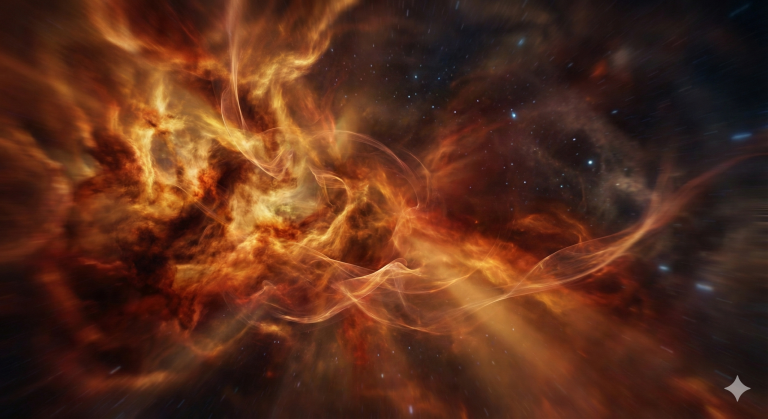
Imagine turning on a computer: not just a laptop, but the computer (Fine-Tuned Universe). Before the screen flickers to life, before the operating system boots, there is a fundamental initialization process. It was an initialization period where the fundamental physical constants and interactions became fixed. Now, scale that up to the cosmos. That, in essence, is what happened in the first trillionth of a second after the Big Bang. It wasn’t just an explosion in space; it was the birth of space-time, the seeding of matter, and the etching of the laws of physics themselves. It was the ultimate hardware initialization that set the stage for the conditionally habitable universe.
The Inflationary Epoch: Formatting the Fine-Tuned Universe
We often think of the Big Bang as a single, chaotic firework, but modern cosmology paints a picture of a sophisticated, multi-stage event. It began with a period of super-luminal expansion called Inflation.
Occurring roughly between 10-36 and 10-32 seconds after the hypothetical “zero point,” this phase was critical. Inflation expanded space so rapidly that it smoothed out initial density irregularities, resulting in the nearly uniform cosmic microwave background we observe. This rapid stretching ironed out initial wrinkles, creating the uniform cosmic background we observe today. Crucially, it also locked in the “seeds” of structure. Inflation amplified tiny quantum fluctuations into the large-scale density variations that would eventually become the gravitational anchors for galaxies, stars, and ultimately, us [1].
The Cosmic Freezings: Installing the Operating System
Once inflation subsided, the universe was still an unrecognizable, ultra-hot fog of energy. As it expanded, it began to cool. This cooling triggered a cascade of events known as “cosmic freezings” or phase transitions.
Think of it like water freezing. As the temperature drops, water molecules transition from a chaotic liquid to a geometrically ordered crystalline structure (ice). Similarly, as the early universe cooled, the fundamental forces of nature separated from a unified, symmetrical state into the distinct forces we experience today [2].
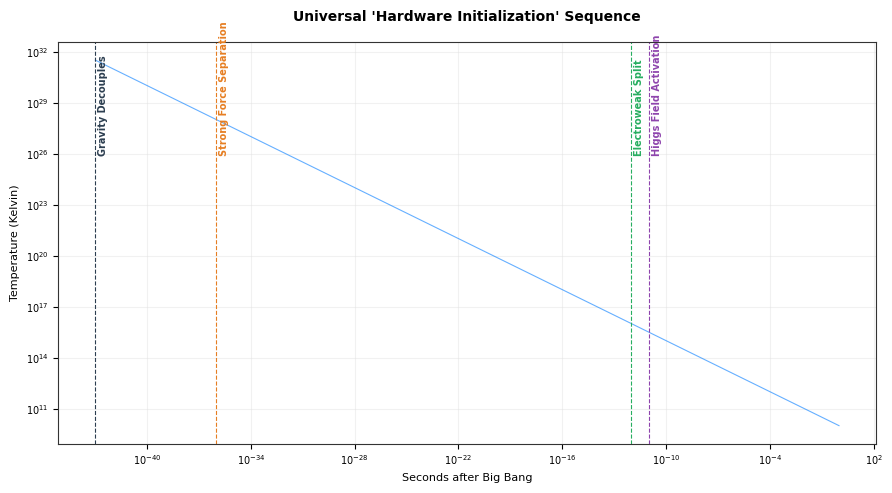
The prevailing theory suggests that initially, gravity, electromagnetism, the weak nuclear force, and the strong nuclear force were fused into a single “superforce.”
- Gravity was likely the first to decouple and go its own way [2].
- As temperatures dropped further, the Strong Force (which holds atomic nuclei together) separated from the others.
- Finally, the Electroweak Force split into Electromagnetism and the Weak Nuclear Force.
Each of these “freezings” wasn’t just a separation; it was the the emergence of distinct physical laws as the universe’s symmetry was broken. For instance, the Higgs mechanism activated during this era. Before this moment, particles like quarks and electrons had no mass; they zipped around at the speed of light, unable to slow down or bond. When the Higgs field “froze” into place (spontaneous symmetry breaking), it gave these particles mass, allowing them to eventually slow down and form stable structures [3].
Why This Matters for Intelligent Life
It is difficult to overstate how precisely the fundamental constants of nature emerged during symmetry breaking and fall within a range that permits the existence of complex structures. This cosmic setup is often viewed as a fundamental precondition that must be met before the ‘Great Filter’ of biological evolution can even begin, a prerequisite that must be satisfied before any stars, planets, biology, or intelligence can exist [4].
Consider the strong nuclear force which plays a vital role in defining the universe’s nuclear inventory and stellar energy production. While nuclear physics is sensitive to percent-level changes, the viable parameter space for life is broader than often claimed. For instance, a slightly weaker force would leave the deuterium nucleus unbound, disrupting a critical first step in Big Bang Nucleosynthesis. Conversely, a stronger force would lead to stable diprotons. Although often labeled a “disaster” due to potentially enhanced reaction rates, research suggests stars could still function normally at lower temperatures. Ultimately, while the strong force must remain powerful enough to prevent nuclear fission of essential elements like carbon, it exhibits sensitivity to fine-tuning. [5].
The gravitational constant is equally critical. Gravity is characterized by “Hierarchical Fine-Tuning” due to its extraordinary weakness compared to other fundamental forces. This is reflected in the tiny value of the gravitational structure constant, approximately , which enables a vast separation of mass and length scales. If gravity were significantly stronger, the range of astrophysical scales would shrink, moving the limit for black hole formation closer to the scale of planets. Furthermore, if gravity were too strong relative to electromagnetism, the minimum mass for star ignition could exceed the maximum stable mass, potentially preventing the existence of working stars entirely [7].
Less obvious, but just as fundamental, is the cosmological constant, or vacuum energy density, which governs the large-scale expansion of the universe. Its observed value is nearly 120 orders of magnitude smaller than theoretical expectations, yet the window for structure formation is narrow. A vacuum energy density that is too large and positive suppresses the formation of galaxies and dark matter halos by preventing matter from becoming gravitationally bound. Conversely, a large negative value would cause the universe to re-collapse into a singularity too quickly for life to evolve. However, this bound is not absolute; if parameters like primordial fluctuations are varied, the universe can tolerate much higher vacuum energy while still forming complex structures [7].
The hardware initialization of the universe’s first fraction of a second did not merely create a conditionally habitable universe. The physical laws established in the early universe resulted in a environment that allows for the complexity we observe today, including the formation of stars and life.
What Comes Next?
By the end of this first fraction of a second, the universe had its laws. Gravity was ready to pull, the Strong Force was ready to bind, and the Higgs field had granted mass to particles. The hardware was initialized, and the operating system was installed.
But a computer is useless without data, and an engine is useless without fuel. The universe was now a structured void with physical laws, but it was chemically empty. It was a hot, dense vacuum waiting for its first real ingredients.
In the next post, we will look at the first few minutes that followed, when the cosmos acted as a nuclear forge to cook up the “Primordial Soup”, the very specific mixture of high-energy elements that would eventually power every star in the sky.
References
- [1] Guth, A. H. (1981). “Inflationary universe: A possible solution to the horizon and flatness problems.” Physical Review D, 23(2), 347.
- [2] Sami, M., & Gannouji, R. (2021). Spontaneous symmetry breaking in the late Universe and glimpses of early Universe phase transitions. International Journal of Modern Physics D, 30(14).
- [3] Higgs, P. W. (1964). “Broken Symmetries and the Masses of Gauge Bosons.” Physical Review Letters, 13(16), 508.
- [4] Barnes, L. A. (2011). The fine-tuning of the universe for intelligent life. Publications of the Astronomical Society of Australia, 29(4), 529-564.
- [5] Smith, E., & Morowitz, H. J. (2016). The Origin and Nature of Life on Earth: The Emergence of the Fourth Geosphere. Cambridge University Press.
- [6] Rees, M. J. (2000). Just Six Numbers: The Deep Forces That Shape the Universe. Basic Books.
- [7] Adams, F. C. (2019). The degree of fine-tuning in our universe—and others. Physics Reports, 807, 1-111.