From Slime to Shakespeare: Beating the Biological Odds (Great Filter)
If you are reading this, you are the winner of a lottery so rigorous that the odds of winning are practically indistinguishable from zero. The journey from slime to Shakespeare was not guaranteed. It required overcoming specific biological bottlenecks.
In our previous posts, we discussed how the universe itself seems fine-tuned for our existence. But even in a universe hospitable to physics, life is not guaranteed. The silence of the cosmos; the Fermi Paradox; suggests that while planets may be common, civilizations are not. This brings us to the “Great Filter” theory: the idea that the path from dead matter to star-faring intelligence is punctuated by specific, treacherous hurdles that almost nothing survives [1].
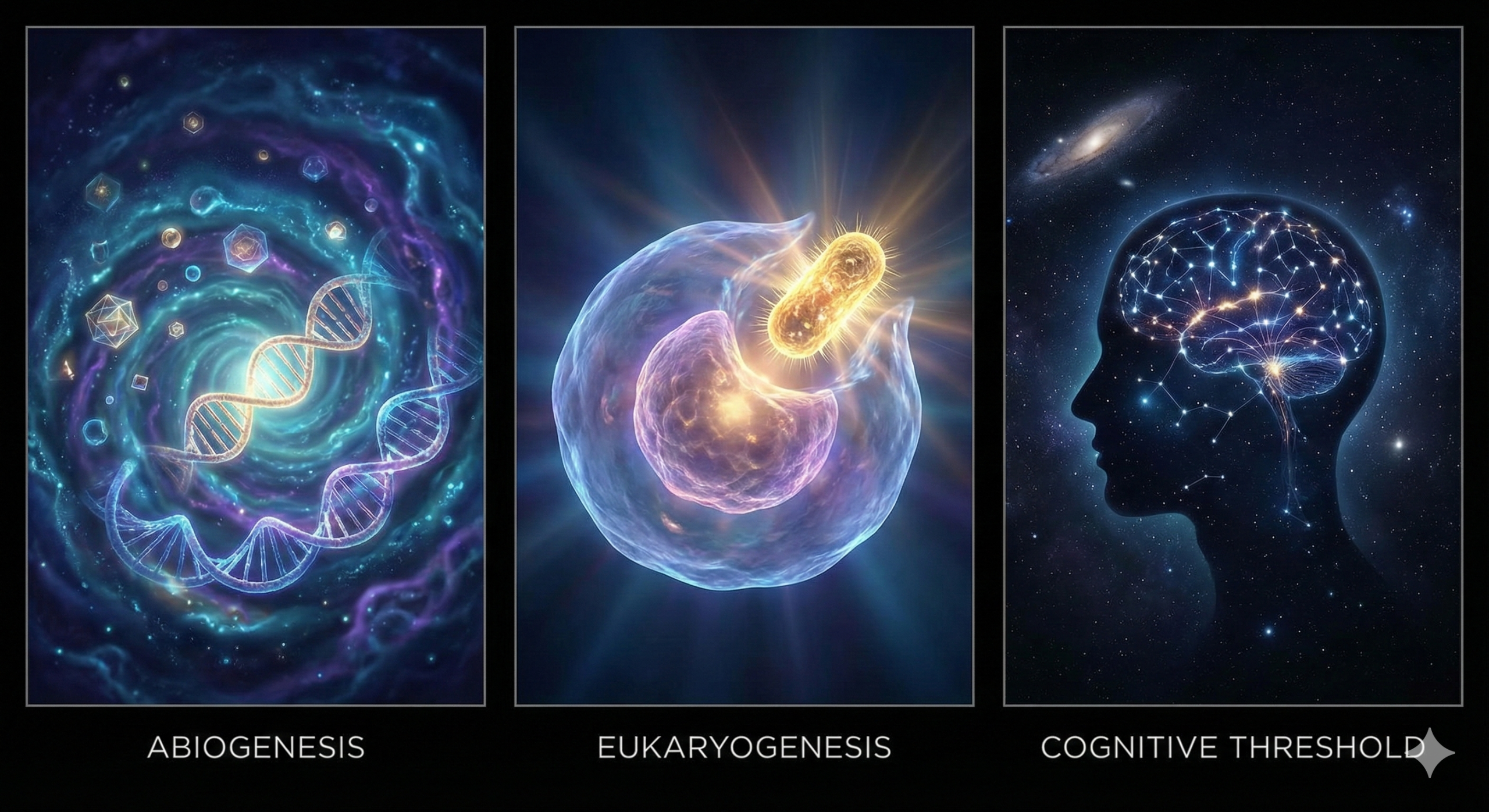
The history of Earth is not a smooth ascent, but a series of improbable bottlenecks. Here are the three hardest steps life had to clear to become us.
Abiogenesis: The Spark in the Dark
The first hurdle is the transition from chemistry to biology; abiogenesis.
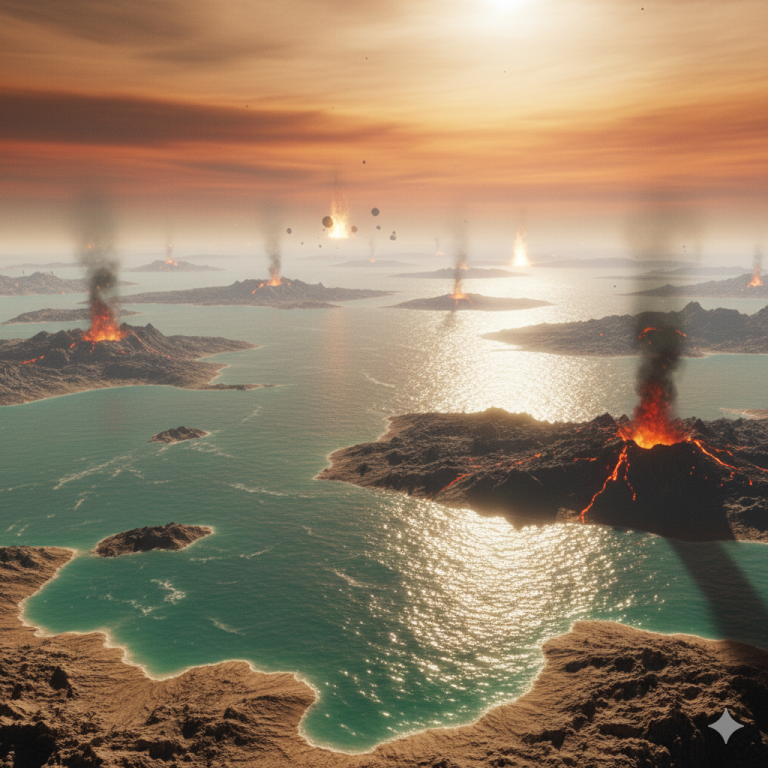
Roughly 4 billion years ago, on a hellish, young Earth, non-living chemicals somehow organized themselves into self-replicating code. This wasn’t just a matter of waiting for the right “soup.” It required a massive departure from thermodynamic equilibrium. As physicists Eric Smith and Harold Morowitz describe it, life is a “phase transition” that opens new channels for energy flow, much like lightning relieves a charge imbalance in the atmosphere [2].
While we have mapped the history of life back to a Last Universal Common Ancestor (LUCA) that lived about 3.5 to 3.8 billion years ago [3], the actual moment of ignition remains a black box. We have never replicated this event in a lab. We can synthesize amino acids and simple sugars, but we have never seen them spontaneously assemble into a self-sustaining cell.
The fact that it happened so early on Earth suggests it might be chemically inevitable given the right conditions. However, all life on Earth descends from that single lineage. We see no evidence of multiple, independent “trees of life” competing with us. Until we find microbes on Mars or Enceladus, we must face the possibility that this first spark is vanishingly rare.
Eukaryogenesis: The Great Gulp
If starting life is hard, making it complex might be even harder.
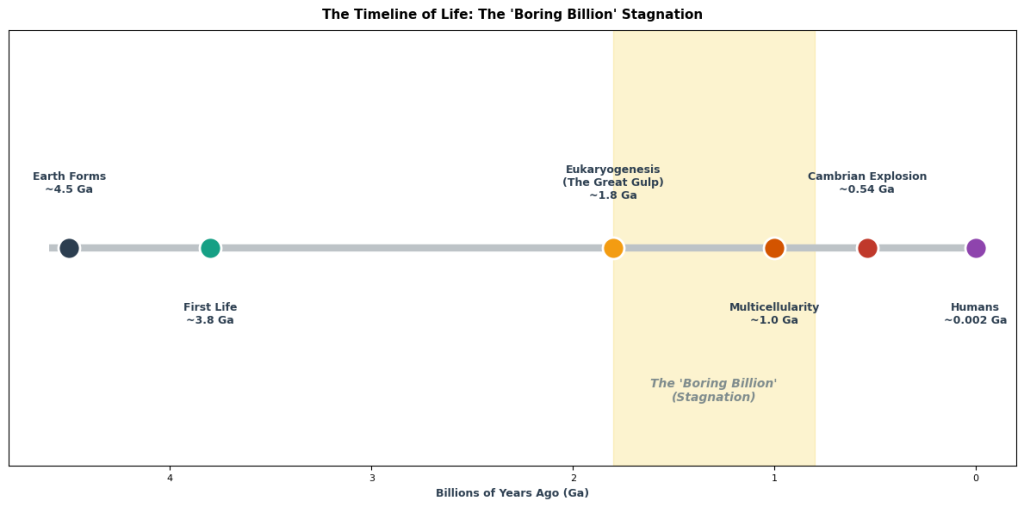
For the first 2 billion years of life’s history, Earth was dominated by bacteria and archaea. This long stagnation is often called the “Boring Billion” [4]. These organisms were biochemically ingenious but morphologically simple, forever constrained by the laws of physics.
Then, a singular, freak event occurred. An archaeon swallowed a bacterium. Instead of digesting it, the two entered into a symbiotic relationship. The swallowed bacterium evolved into the mitochondrion, the powerhouse of the cell.
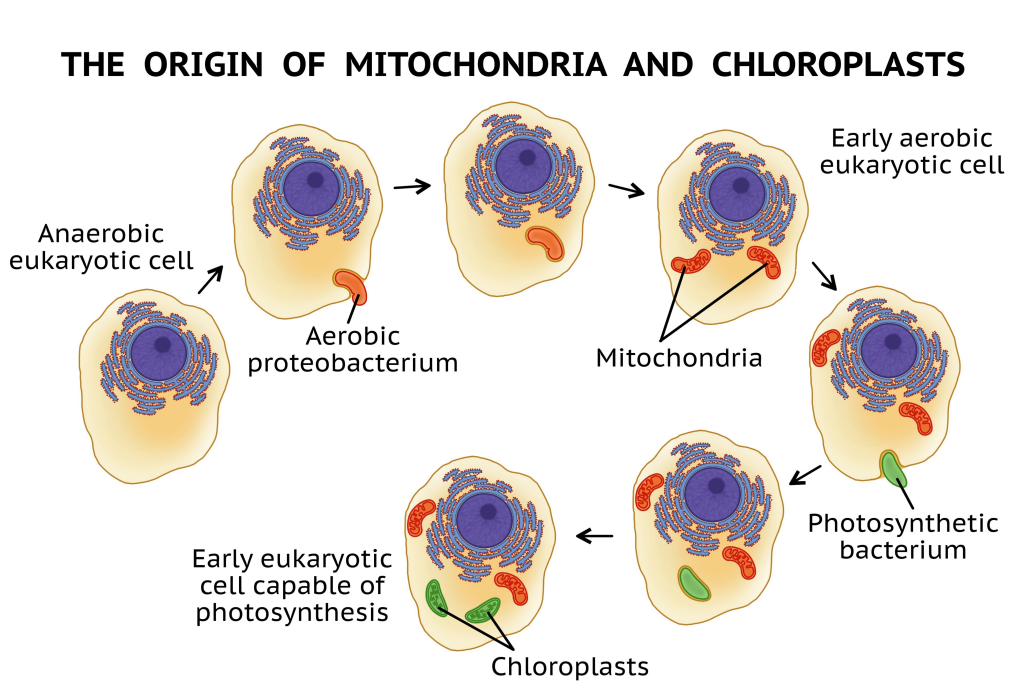
Biochemist Nick Lane argues that this event, eukaryogenesis, was the critical energetic key. Bacteria generate energy across their outer membrane, which limits their size; if they get too big, they can’t generate enough power to support their volume. By internalizing the power plants (mitochondria), the new “eukaryotic” cell broke this energy barrier, increasing the energy available per gene by orders of magnitude [5].
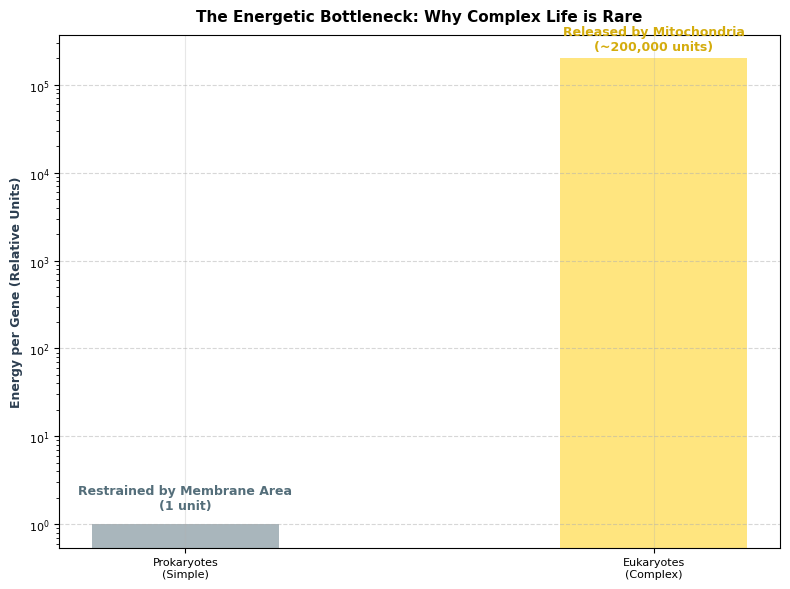
Suddenly, life had the energy budget to build complex structures and eventually, multicellular bodies. But here is the kicker: as far as we know, this endosymbiosis happened exactly once in 4 billion years. Without this one-time biochemical merger, Earth would likely still be a world of slime.
The Cognitive Threshold: The Expensive Brain
The final great filter is the leap from complex life to intelligent life.
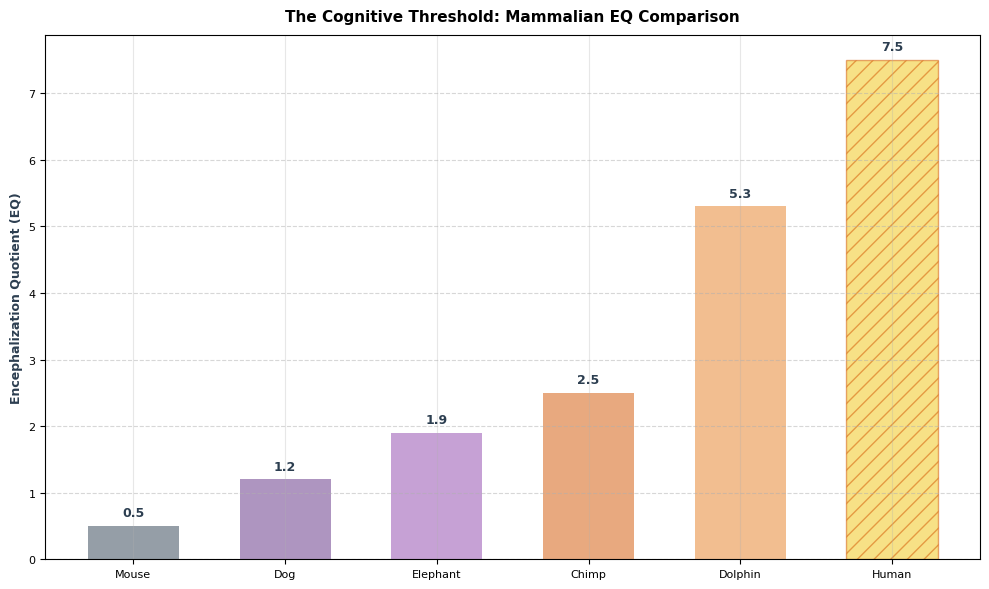
There is a misconception that evolution inevitably moves toward intelligence. It does not. Evolution selects for survival and reproduction. Intelligence is biologically expensive. The human brain consumes about 20% of the body’s energy while representing only 2% of its mass [5]. For most species, that return on investment is terrible.
Complex life existed for hundreds of millions of years, through dinosaurs and massive marine reptiles, without producing a technological civilization. It took a specific set of evolutionary pressures to force the rapid expansion of the hominid brain. This likely involved “neuro-cognitive leaps” toward recursive language, the ability to embed thoughts within thoughts (e.g., “I think that you think that I am lying”) [6].
We are the anomaly. We are the only species that has breached this cognitive threshold to the point of building radio telescopes. The fact that we are alone on Earth in this capacity suggests that high intelligence is not a favored outcome of evolution, but a rare, energy-intensive fluke.
The Verdict
The “Great Filter” suggests that one of these steps is nearly impossible to pass. If Abiogenesis is the filter, the universe is empty of life. If Eukaryogenesis is the filter, the universe is full of bacteria but devoid of animals. If the Cognitive Threshold is the filter, the galaxy may be a zoo, but there is no one else to talk to.
We have cleared them all. Whether by necessity or by chance, we are the lucky ones.
References
- Hanson, R. (1998). The Great Filter — Are We Almost Past It?
- Smith, E., & Morowitz, H. J. (2016). The Origin and Nature of Life on Earth: The Emergence of the Fourth Geosphere. Cambridge University Press.
- Hazen, R. M. (2012). The Origin and Evolution of Earth: From the Big Bang to the Future of Human Existence. The Teaching Company / The Great Courses.
- Brasier, M. D., & Lindsay, J. F. (1998). A billion years of environmental stability and the emergence of eukaryotes: New data from northern Australia. Geology, 26(6), 555–558.
- Lane, N. (2015). The Vital Question: Why Is Life The Way It Is? Profile Books.
- Corballis, M. C. (2011). The Recursive Mind: The Origins of Human Language, Thought, and Civilization. Princeton University Press.
- Roth G, Dicke U. Evolution of the brain and intelligence. Trends Cogn Sci. 2005 May;9(5):250-7. doi: 10.1016/j.tics.2005.03.005. PMID: 15866152.