The Primordial Soup: Big Bang Nucleosynthesis to an Intelligent Life
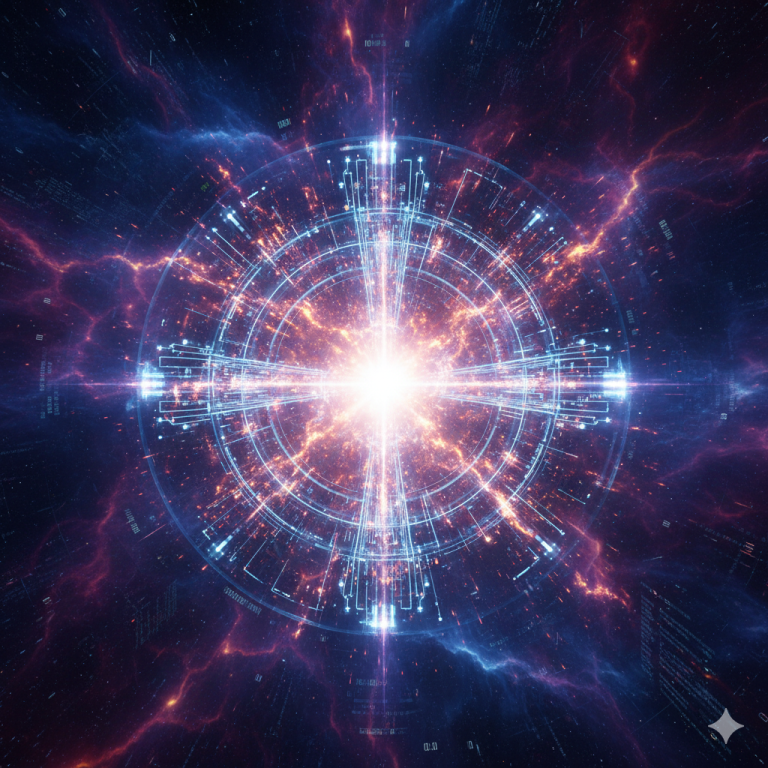
Imagine the universe as a giant, cosmic kitchen, but with only hydrogen and helium on the shelves. This is an accurate depiction of the cosmos in its earliest moments, seconds after the Big Bang. For the initial minutes, the universe existed as a searingly hot “primordial soup,” a dense environment where only hydrogen (approximately 75%) and helium (almost 25%), with a tiny bit of lithium, could form. This critical phase is known as Big Bang Nucleosynthesis, the era in which the cosmos forged its very first light elements.
This brief period played a crucial role in determining everything that followed, setting the stage for the entire cosmic drama. But how did we get from a singular explosion to the structured, star-filled expanse we see today? The answer lies in four distinct acts that transformed a chaotic inferno into a transparent cosmos ready for life.
Act I: Big Bang Nucleosynthesis (The Universe as a Fusion Reactor)
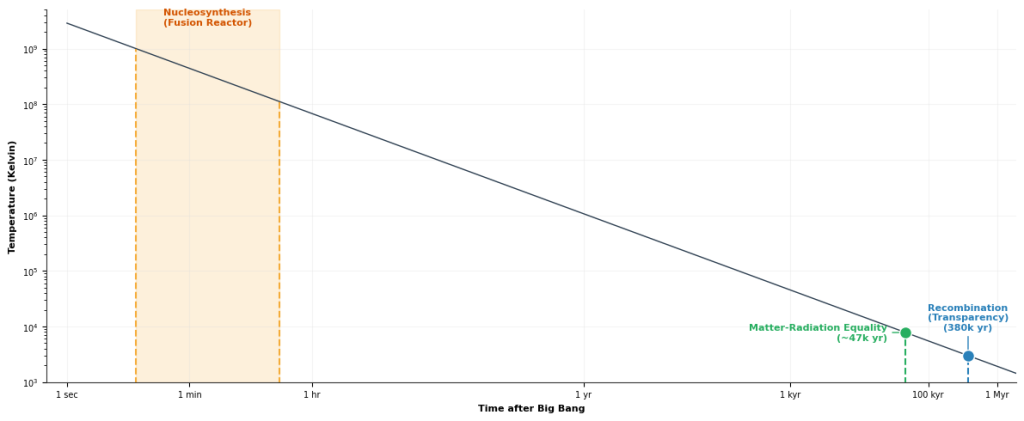
The process that governed the elemental composition of this soup is known as Big Bang Nucleosynthesis, or BBN. This intense activity occurred from approximately 10 seconds to just 20 minutes after the Big Bang. At the 10-second mark, the universe had cooled just enough, to about a billion Kelvin, that protons and neutrons could finally slam together and stick without being instantly blasted apart by high-energy photons.
Imagine free protons and neutrons colliding, fusing to form deuterium, helium-3, helium-4, and a trace of lithium-7. As the universe expanded, the temperature dropped, quickly quenching the nuclear reactions and preventing the formation of heavier elements. By the 20-minute mark, the universe’s composition was effectively “frozen.”
The window of opportunity closed too quickly. However, this frozen ratio, roughly 75% Hydrogen and 25% Helium by mass, remains one of the strongest pieces of evidence for the Big Bang today. Scientists study ancient gas clouds and metal-poor stars to determine their elemental composition, and these observations consistently confirm the predictions of BBN [1].
Act II: The Era of Radiation Domination (10 Seconds – 47,000 Years)
For thousands of years the energy density of radiation (light) exceeded the density of matter. This was the era of the Opaque Plasma. Although atomic nuclei now existed, the universe was still far too hot for them to hold onto electrons. Consequently, free electrons roamed everywhere, acting like a dense fog. A photon could travel only a tiny distance before hitting an electron and bouncing off. If you could exist there, you wouldn’t be able to see your hand in front of your face; space was a glowing, opaque fog of trapped light [2].
Act III: The Tipping Point (Matter-Radiation Equality)
Around 47,000 years after the Big Bang, a critical crossover occurred. As the universe expanded, the wavelength of light stretched (redshifted), causing radiation to lose energy faster than matter lost density. This moment, known as Matter-Radiation Equality, marked the point where the density of matter (both dark and atomic) finally exceeded the energy density of radiation. This was crucial for structure formation. Once matter became the dominant form of energy, gravity could begin to amplify tiny fluctuations in density effectively, starting the slow process of building the “seeds” for future galaxies [3].
Act IV: Recombination & The Cosmic Microwave Background
The finale of the early universe’s “hot phase” arrived around 380,000 years after the Big Bang. By this time, the temperature had dropped to around 3,000 Kelvin, roughly the surface temperature of a red star. This cooling allowed for Recombination [4].
Recombination had a profound impact on the universe’s transparency. With the formation of neutral atoms, the number of free charged particles plummeted, allowing photons to travel vast distances. The universe effectively became transparent for the first time, allowing light to stream freely. The light released during this recombination event is what we observe today as the Cosmic Microwave Background (CMB), a faint afterglow of the Big Bang. The CMB exhibits tiny fluctuations in temperature, which reflect subtle variations in the density of matter in the early universe. These fluctuations represent the seeds of larger structures that would eventually form [5].
The Dark Ages: Gravity’s Long Wait
Following recombination, the universe entered the “cosmic dark ages”. This was a time of relative quiescence before the formation of the first stars and galaxies. Space was primarily filled with diffuse clouds of neutral hydrogen and helium, along with dark matter. However, in the dark, gravity was at work. The slight variations in the density of matter, imprinted during the earlier eras, began to grow [6]. Dark matter played a critical role here, clumping together earlier than ordinary matter and creating gravitational “wells” that pulled in the hydrogen gas. Over vast stretches of time, these regions became so dense that they collapsed under their own gravity, igniting the first stars and galaxies.
Why This Matters for Intelligent Life
From an astrobiological perspective, the primordial soup was chemically impoverished, lacking the heavier elements crucial for DNA-based life. Without these elements, the formation of rocky planets would have been impossible.
However, the sheer abundance of hydrogen provided the essential fuel for the nuclear fusion reactions that power stars. It was the necessary first step, the fundamental prerequisite for everything that followed. In essence, the evolution of the early universe followed a crucial sequence: first fuel (hydrogen and helium), then fire (nuclear fusion in stars), then the potential for life.
The initial conditions set by the Big Bang, BBN, and Recombination established the foundation upon which all subsequent cosmic development would occur. Without this essential “primordial soup,” the universe as we know it would simply not exist.
What’s Next?
Your atoms were forged in violence; born inside stars that lived fast and died young. But that is only the beginning. Those elements had to accumulate, generation after generation, until the universe crossed a critical threshold: enough metals to build rocks, chemistry, and minds.
In the next post, we follow that climb toward metallicity; how countless stellar deaths quietly enriched the cosmos, and why intelligence depends not on one star, but on many. Before life could think, the universe first had to learn how to recycle its dead!
References
- [1] Grohs, E., Fuller, G. M. (2023). Big Bang Nucleosynthesis.
- [2] Hu, W., Dodelson, S. (2002). Cosmic Microwave Background Anisotropies. Annual Review of Astronomy and Astrophysics, Vol. 40, pp. 171-216.
- [3] Planck Collaboration: N. Aghanim et al. (2020). Planck 2018 results. VI. Cosmological parameters. Astronomy & Astrophysics, Vol. 641, A6
- [4] NASA. (n.d.). What Can We Learn from the Universe’s Baby Picture? NASA Science.
- [5] NASA. (n.d.). Microwave Background Power Spectrum. Legacy Archive for Microwave Background Data Analysis (LAMBDA). NASA Science.
- [6] Barkana, R., & Loeb, A. (2001). In the beginning: the first sources of light and the reionization of the universe. Physics Reports, 349(2), 125-238.