
Plate Tectonics: 7 Incredible Reasons It’s the Engine of Life
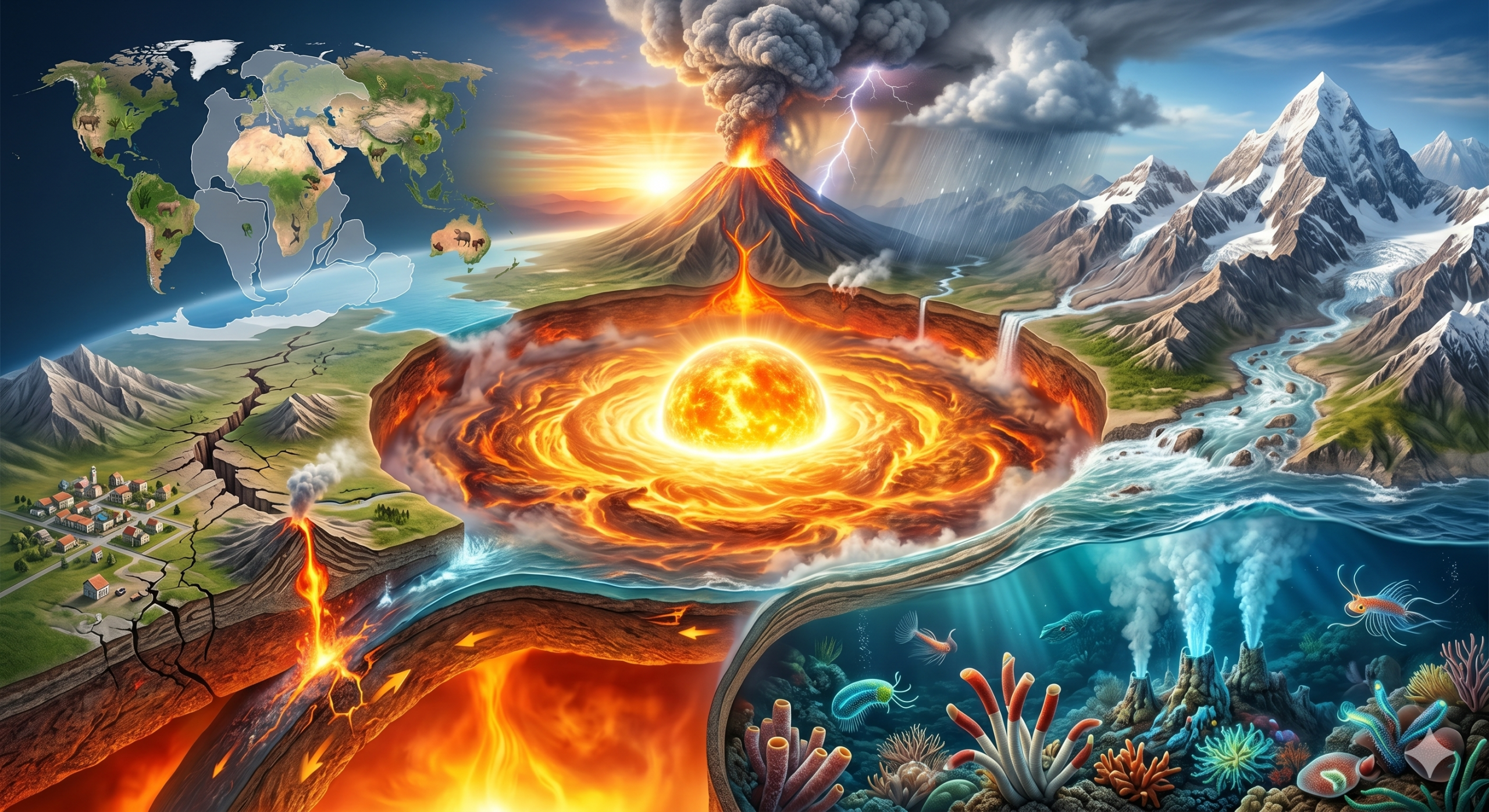
Earth is a dynamic planet, a world in constant flux characterized by a swirling interior of molten rock and shifting surface plates. While we often perceive plate tectonics through the lens of dramatic natural disasters like earthquakes and volcanic eruptions, these events are merely symptoms of a much grander, fundamental process: the continuous recycling of the Earth’s crust.
This restless activity is unique in our solar system as far as we know. It isn’t just geological drama; it is the vital engine that drives and sustains life, maintaining a habitable environment and fueling the biosphere in ways we are only beginning to fully understand. By exploring the interplay of tectonics with Earth’s other systems, we can see why our planet remains a living world.
1. The Living Skin: A Constant Cycle of Renewal
Plate tectonics is the theory that the Earth’s outer layer, the lithosphere, is divided into several large and small plates. These plates “float” on the semi-molten layer below, constantly moving, colliding, and sliding past one another. The most critical aspect of this movement for life is subduction. This occurs when one plate, typically a dense oceanic plate, slides beneath another and dives into the Earth’s mantle. This process buries crustal material deep underground, effectively recycling it. Earth is currently the only known planet with active subduction [1], a key characteristic for sustaining a biosphere for billions of years.
2. The Global Thermostat: Regulating Temperature
One of the most essential roles of tectonics is its influence on the carbon cycle, which acts as Earth’s natural thermostat. Carbon dioxide (CO2) in the atmosphere is a greenhouse gas that traps heat, keeping the planet warm. However, without regulation, (CO2) levels could lead to a runaway greenhouse effect like that seen on Venus, or a total freeze. Plate tectonics regulates CO2 through a complex feedback loop:
Carbon Sequestration: Atmospheric CO2 dissolves in rainwater to form a weak acid that weathers rocks, locking carbon away in sediments.
Volcanic Outgassing: These sediments are carried to subduction zones, melted, and eventually released back into the atmosphere via volcanic eruptions.
Without this volcanic return mechanism, Earth would gradually cool as carbon was continuously sequestered, eventually freezing over completely [2].
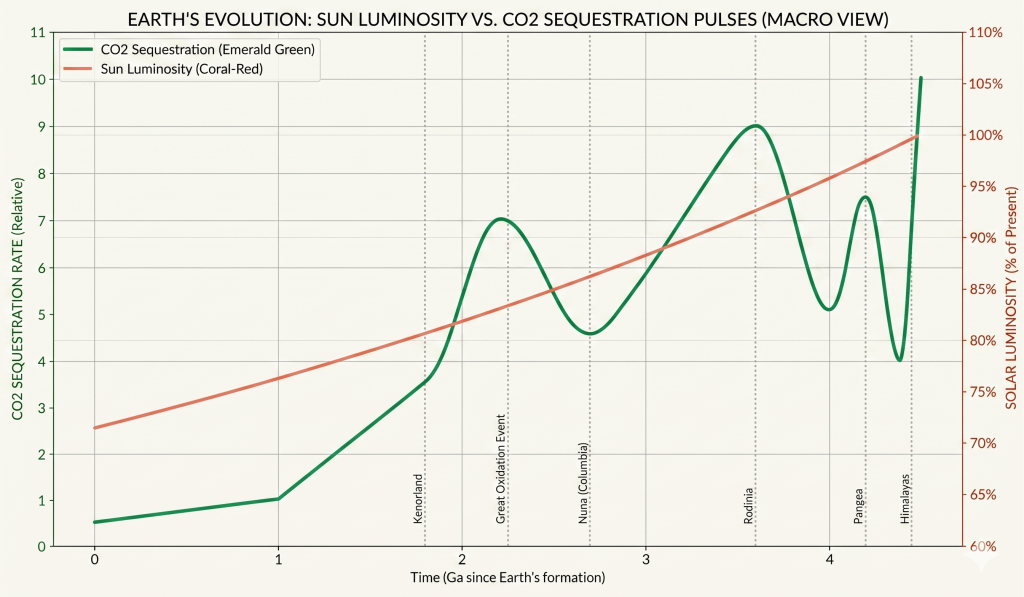
The CO2 Sequestration Chart visualizes Earth’s “ramping up” of carbon removal to counter a warming Sun. Over 4.5 billion years, as solar luminosity increased by ~30%, the Walker Feedback Mechanism accelerated the chemical weathering of rocks to pull CO2 from the atmosphere. The “pulses” in the line represent major tectonic events, like the formation of the Himalayas, which exposed fresh rock and caused surges in sequestration. This continuous, self-correcting cycle ensures that as the planet heats up, the tectonic engine works harder to cool it down.
3. Nutrient Recycling: Feeding the Biosphere
Life requires more than just water; it needs essential nutrients like phosphorus and iron. Tectonics acts as a delivery system for these elements. The massive forces that uplift mountains, driven by tectonic activity, expose “fresh” rock to the elements. Weathering and erosion then release these vital minerals, which rivers transport to the oceans. This replenishment is crucial for phytoplankton, the microscopic organisms that form the base of the marine food web. Without tectonic uplift, the oceans would eventually become nutrient-depleted, leading to a collapse of marine ecosystems.
4. Avoiding Stagnation: Maintaining Chemical Disequilibrium
Life thrives on chemical disequilibrium, using the energy released by shifting chemical states to power biological processes. In a closed system without external forces, chemicals eventually reach equilibrium, a stagnant state where no more energy can be extracted. Plate tectonics prevents this “biological starvation.” By constantly introducing fresh materials into the mantle and releasing new gases and minerals into the atmosphere and oceans, tectonics disrupts the chemical balance. This constant flux provides the chemical energy that fuels the base of the tree of life.
5. Creating Habitats: Continents and Shelves
The very ground we walk on is a tectonic legacy. Over billions of years, subduction and volcanism have built up the lighter, granitic continental crust. Because this crust is less dense than the basaltic ocean floor, it “floats” higher on the mantle, providing a stable platform for terrestrial life to evolve. Furthermore, the movement of these plates creates shallow continental shelves. These sunlit, nutrient-rich “nurseries” are ideal for marine life, providing the perfect conditions for early complex organisms to take hold and thrive.
6. The “Great Filter” of the Universe
Given its vital role, scientists suggest plate tectonics may represent a “Great Filter”, a hypothetical barrier that prevents the emergence of complex, intelligent life elsewhere in the universe.
Mars: Likely had an active geological past, but as its internal heat dissipated, tectonic activity ceased. This led to a loss of atmosphere and a frozen, dry surface.
Venus: May have lost its tectonic activity early on, resulting in a hostile, runaway greenhouse environment.
This suggests that while many planets might host simple life briefly, only those with active tectonics can remain habitable over the billions of years required for complex evolution.
Why this matters for intelligent life
Understanding the role of plate tectonics is essential for assessing the potential for life elsewhere, but it also has profound implications for us as humans. If active tectonics is a rare and essential ingredient for long-term habitability, the conditions necessary for complex life to arise and persist are far more stringent than previously thought.
Furthermore, the absence of these processes would not only impact the emergence of civilizations like ours but would hinder their long-term survival by preventing the development of advanced technologies and a sustainable presence in the cosmos. By studying Earth’s dynamic systems, we gain valuable insights into how to maintain a habitable environment for future generations. If Earth is truly unique in its geological engine, we have more reason than ever to protect the only planet we inhabit.
The Earth’s geological engine is constantly working under our feet, shaping the world we know. We have much more to explore about how Earth has fostered life for billions of years, and if those processes can be found elsewhere. So how else can geology generate life? Prepare to dive deep into the ocean and explore the powerful role of hydrothermal vents in our next blog: Life’s Original Battery: The Power of Deep-Sea Vents.
References:
[1] Gang Lu, Liang Zhao, Ling Chen, Bo Wan, and FuYuan Wu (2021). Reviewing subduction initiation and the origin of plate tectonics: What do we learn from present-day Earth? Earth and Planetary Physics. 5:123–140, 202.
[2] Gernon, T.M., Hincks, T.K., Merdith, A.S. et al. Global chemical weathering dominated by continental arcs since the mid-Palaeozoic. Nature Geoscience 14, 690–696 (2021).